
THE YEAR 1745: FRANCE–SCOTLAND–CULOODEN
A mysterious and very risky trip to Scotland
On June 21, the Prince boarded the privateer ship “Du Teillay” in Saint-Nazaire, accompanied by the legendary men known as the “Seven Men of Moidart,” who were: Duke William of Atholl, Aeneas MacDonald, a banker from Paris; Francis Strickland, a descendant of an old and loyal family from Westmoreland; Sir Thomas Sheridan; George Kelly, a pastor and schemer; Sir John MacDonald, a veteran of the French cavalry; and John William O’Sullivan, who had extensive military experience. However, fate was not on the expedition’s side, and on July 9, a clash occurred between HMS Lyon of the British Navy and the “Elizabeth” and “Du Teillay” of the French Navy. After a fierce battle, the “Elizabeth” and HMS Lyon returned to their respective ports with damage, while the Prince sailed toward Scotland with only one ship.
On the second ship, which returned to its home port, he left behind some of the supplies that had been so desperately needed during the 1745 uprising. It should be added that the two ships carried 3,500 muskets, 2,400 broad swords, about 20 artillery pieces, ammunition, and a reserve of French louis d’or coins, some of which were gold. All of this was financed by loans, which in turn were secured using the Sobieski family’s jewels. The entire operation was conducted in the utmost secrecy from the French government and from the Prince’s father. It was only after the expedition had begun that letters were sent out informing recipients of the unyielding Prince’s planned actions.
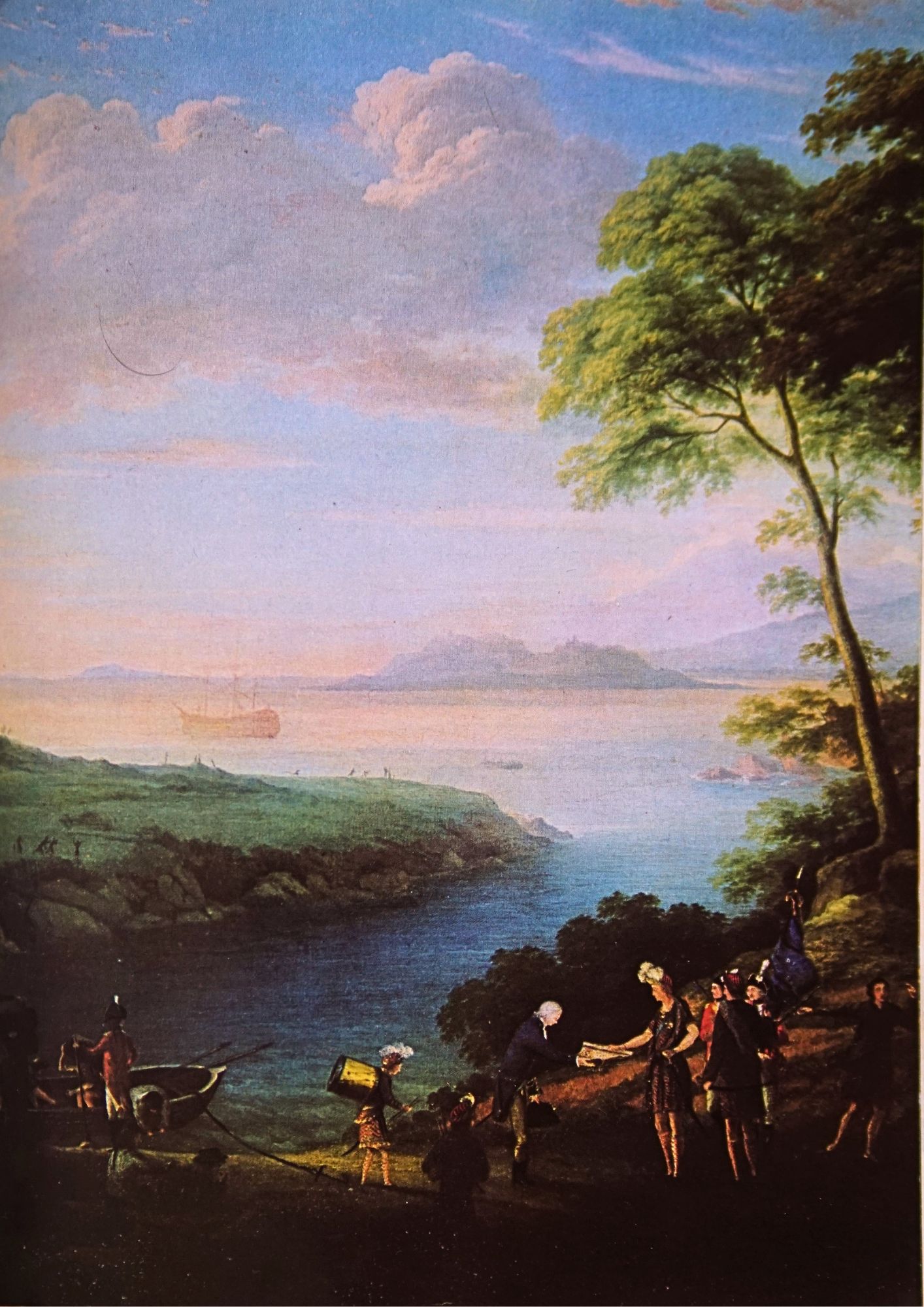
On July 23, the ship’s commander, Walsh, dropped anchor off the coast of the island of Barra. Unexpectedly, he learns that not everyone is pleased to see him, and he receives clear signals to retreat from the Duke of Atholl and Sheridan. Sir Hector MacLean of Duart is also arrested, but none of this discourages the Prince, who is supported by Captain Walsh. On the island of Eriskay, Alexander MacDonald of Boisdale says the following to the Prince: “Go home.” In response, the Prince says, “That is exactly what I did by coming here to Scotland.” The clan chiefs from the Isle of Skye—Sir Alexander MacDonald of Sleat and Norman MacLeod refuse to cooperate, claiming they will not take part in this risky venture against the English without explicit support. Prince Charles does not give up, though it must be admitted that things did not look promising.
With little optimism but great enthusiasm, he sets off inland to the Catholic region between Arisaig and Moidart, where he learns that Ranald will follow his rightful prince, even if no other man in Upper Scotland were to draw his sword. On August 6, he informs the King of France of his arrival in Scottish territory, appealing for aid and military support. According to Lord Lochiel, 6,000 soldiers are the absolute minimum required to prevent the mission from becoming a suicide mission. Many were skeptical at the time, but how could anyone resist the prince’s powers of persuasion and charm? As he himself claimed, “In a few days, together with the few friends I have, I will raise the royal standard and announce to the people of Great Britain that Charles Stuart has come to reclaim the crown of his ancestors—to win it or die in the struggle.” To confirm this determination, he sent his ship back to France to prove that he had no intention of returning. Arguments regarding France’s assistance in the later stages of the operation, combined with the prince’s resolve, convinced the skeptical MacDonalds of Kinlochmoidart, Clanranald, Glencoe, Keppoch, and the Stewarts of Ardshiel. For over a dozen days, many visited the prince in disbelief, not far from the outpost at Fort William, which was under the control of the English governor.
GLENFINNIAN—RAISING THE BANNER—UNITING FORCES
On August 19, 1945, after several days of traveling in secret and evading British patrols, Prince Charles’s party and the “Seven of Moidart” arrived on the north side of Loch Shiel at a place called Glenfinnian. The prince rested and awaited the arrival of the highlanders. After some time, members of the MacDonald clan from Morar, numbering 150 and led by Rob Roy MacGregor’s son, James Mor, were the first to arrive. However, for the next four hours, no one else showed up. Sometime in the late afternoon, the sounds of bagpipes began to echo from the hills of Lochaber. Everyone seemed to freeze and wait in silence as, in the distance, the Cameron clan—numbering 800 and led by the young Lochiel—could be seen approaching. And they all marched to the strains of an ancient war march. Later, some 350 Highlanders from the Macdonalds of Keppoch and 70 Royal Scots joined them. It must have been an incredible sight to see the Prince marching among an army of 1,200 Highlanders, and he undoubtedly felt that, after so many hardships, he was finally among his own people and that the 1745 uprising had begun. However, before the Highland army set out from Glenfinnian, a symbolic ceremony took place in which a rather old banner was unfurled—one that had sailed over from France with Charles and had participated in previous uprisings. We know that Prince William Murray, along with two men, held the banner while reading the 1743 proclamation declaring Charles’s father, James VIII, King of England, Ireland, and Scotland, and Charles Edward himself Prince Regent. The prince’s closing speech was full of optimism and ended with cheers such as: “Long live King James VIII, long live the Prince of Wales! Prosperity for Scotland—No Union.”
On August 22, during a stop in Kinlochiel, they learned that George II had offered a reward of 30,000£ for the Prince’s head. They then set off along the northern shore of Loch Eil, spending the night of August 22–23 at the Fassieferna house. The year 1746, following the Battle of Culloden, would prove tragic for John Cameron of Fassieferna, as he was imprisoned by the Governor of Fort William for aiding the uprising. There is no denying that everyone knew the consequences that might await them for joining the ranks of the Stuart rebels. Their punishment was as follows: “They are to be hanged one by one by the neck, but not until they die, for they must be beheaded while still alive; then their entrails are to be torn out and burned before their eyes; then their heads are to be severed from their bodies, and their bodies are to be divided individually into four parts.” The Scottish Highlanders were under the shadow of the Hanoverian prince, who had the backing of the national treasury and the navy. He could also summon a powerful army several times larger than their own. Despite this, many preferred to take the risk by speaking openly of their hatred for this absurd, forcibly imposed Union that had lasted 38 years. To add a touch of humor—albeit in an insulting way—they called the Prince of Hanover “Wee wee German lairdie,” which translates to “tiny, tiny German lord.” Despite the clan members’ respect for their chieftains, not everyone was willing to take that risk. However, in such a situation, honor and loyalty to the Stuart dynasty, along with Prince Charles’s charisma, convinced them to join the uprising. It is worth noting that 57 years had passed since the exile of his father, James VII & II, so the Highlanders had had enough of Hanoverian rule and preferred to join the Jacobite cause.
The Prince’s army gradually grew in strength and, a week after setting out, reached the Great Glen. After joining forces with the Stewarts of Appin and the Glengarry MacDonnells, the army numbered 2,000 men. The Hanoverian commander, Sir John Cope, had an army twice as large and held the most important fortresses. These fortresses were—and still are—arranged in a line separating the north from the south. These castles are Edinburgh, Stirling, and Dunbarton. Every day was full of excitement, and events unfolded rapidly. Shortly after setting out, the Jacobites scored one of their first victories in the Battle of Corrieyairack Pass. To General Cop’s surprise, many clan members deserted and defected to the Jacobites. In the south were the Dragoon regiments under the command of General Joshua Guest; however, under pressure and fearing a surprise attack by the highlanders, they withdrew to the coast. At about the same time, 400 men led by MacPherson of Cluny marched toward Perth, joining forces with 400 Cameron highlanders commanded by Lochiel. All the units united into a single army on September 4.
March on Edinburgh
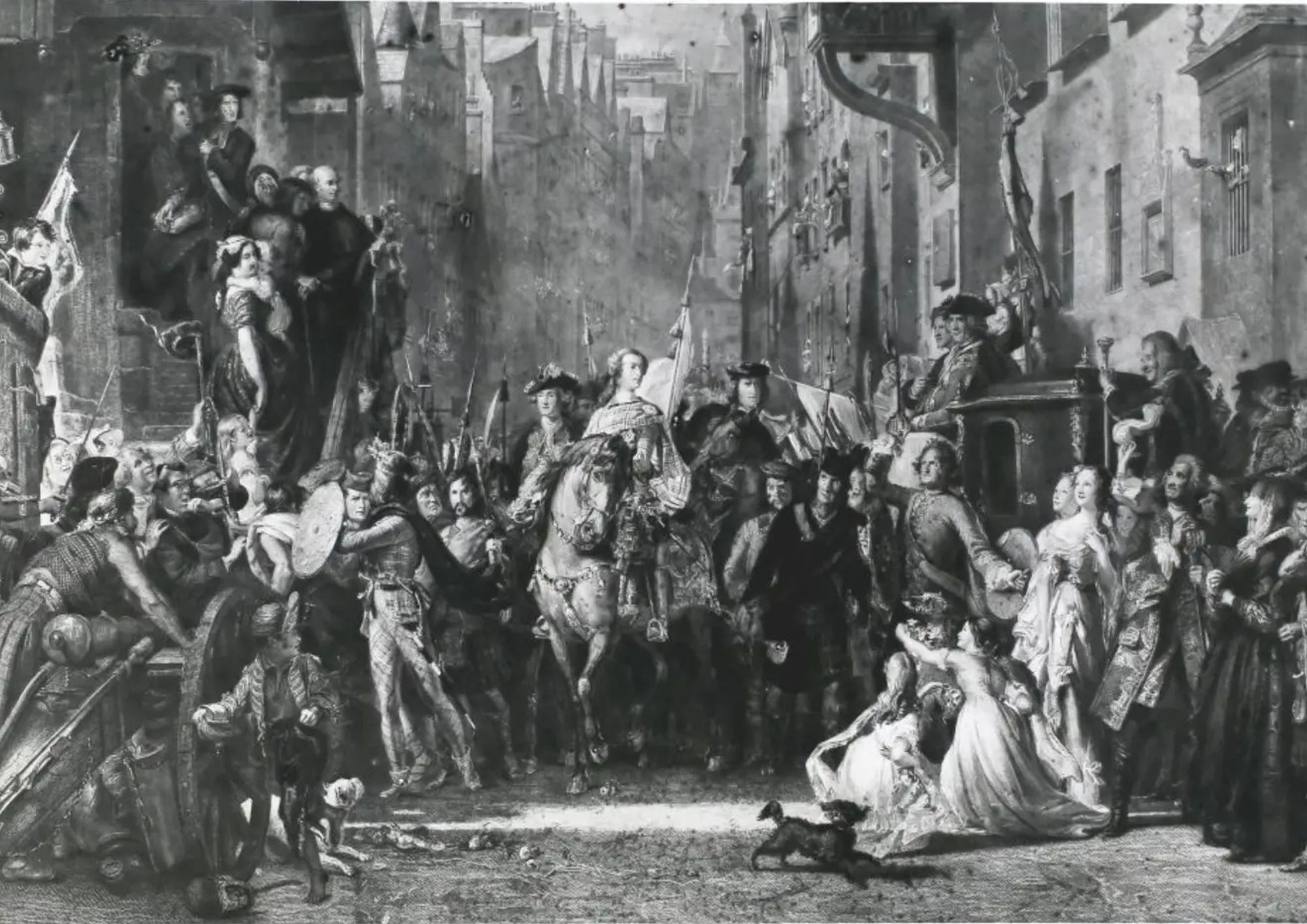
It was then, in early September, that several prominent figures joined the Prince’s Army. These figures included: 51-year-old Lord George Murray, brother of the Duke of Atholl; James Drummond, Duke of Perth; his cousin William, Viscount Strathallan; his cousin David, Lord Ogilvy; and Laurence Oliphant of Gask. All of them would play a very important role, and it is worth taking a closer look at them, but I believe that Lord George Murray played the most significant role—not only because of his temperament but also because of his unyielding nature, which would certainly not entirely help the young Charles in making future decisions. Moving forward to September 17, an army of over 1,000 men, composed of the MacDonalds and the Camerons, was ready to lay siege to the city of Edinburgh. To their surprise, the Neatherbrow Gate was opened, letting out a stagecoach, which Lochiel took advantage of to enter the city at the head of the Highlanders. The city of 40,000 offered no resistance and allowed James Heapburn of Keith, a veteran of the 1715 uprising, to escort Prince Charles—dressed in Highlander attire—toward Holyrood Palace. Charles, of course, hosted more than one ball in the ancient palace of his ancestors, and the scale and fame of these events resonated in a way that had never before accompanied the Stuart ancestors. After about two months in Edinburgh and failing to capture the castle, the Jacobite army set out southward to seize power in London. It is worth mentioning the commander of Edinburgh Castle, who, cut off from food supplies, began firing cannons at the city’s residents. This commander knew that Charles Edward valued the honor of his subjects above all else, which is why he sought to unblock food supplies in this manner—and ultimately succeeded. He asks himself: what kind of ruler would fire on defenseless people? Surely only a Hanoverian. Without wasting another moment—and it’s worth noting that they had already wasted a great deal of time in Edinburgh—the Jacobite army sets out to conquer England.
PRINCE VS GENERAL COPE (THE BATTLE OF PRESTONPANS)
On September 21, at the Battle of Prestonpans, the Highlanders’ army under the command of Charles Edward clashed with General Cope’s army, which was of comparable size. The battle itself, however, did not last long—less than half an hour—thanks to a lieutenant named Robert Anderson, who pointed out a secret path through the marshes. George Murray then led a frenzied infantry charge that forced the Hanoverians to retreat, killing and capturing over 1,000 enemy soldiers while suffering only minor losses of their own. O’Sullivan described the scene as follows: “You cannot imagine the courage inspired by the prince’s actions as he brought order to every regiment, the joy that shone on his face, and how a few words in Gaelic that he addressed to the soldiers gave them all encouragement… He drew his sword and said, ‘Gentlemen, the sword has been drawn. It will not be my fault if I sheathe it before you become a free and happy people.’
After the battle, the prince organized medical aid for everyone, whether enemy or ally, demonstrating an extraordinary chivalric virtue rarely seen. At that time, the following words were recorded as coming from his lips: “I will not rest until I am certain that my poor people, as well as the other wounded, have been cared for, for they, too, are the king’s subjects, and it is not their fault that they were misled.” After that battle, he held all of Scotland, except, of course, for Edinburgh Castle and Stirling, which remained under the control of the Hanoverian garrison. After every battle or skirmish they won—and there were quite a few—new volunteers, inspired by the strength and speed of their military operations, joined the ranks of the Jacobite Army. These included members of the MacKenzie Clan under the command of the Earl of Cromartie, the Atholl Brigade formed by Prince William and Lord George Murray, members of Lord Lewis Gordon’s clan, and a force of 480 men under the command of David Tulloch and John Hamilton. They were also joined by Lord Balmerino, Elcho, Pitsligo, Kilmarnock, and John MacKinnon of Skye.
In addition to military operations, complex campaigns were carried out in which many senior commanders set out on expeditions to win allies for the great cause lost by the House of Stewart. Importantly, three French ships appeared on the horizon carrying artillery supplies and funds amounting to 4,000 guineas, but with only a small number of French soldiers, which did not fully satisfy the Prince. In October, the Prince’s forces numbered 6,000. At that time, Charles Edward Stuart was a young and inexperienced commander, and certain aspects of his preparations or decision-making took too long or were made too hastily. For this reason, the decision to attack England was, on the one hand, unwise, and even after it was made, it remained shrouded in great uncertainty. Had he made his decisions more quickly, he would likely already be closer to London and exerting greater pressure on the Hanoverians, who were frantically mobilizing their troops.
A RAPID MARCH THROUGH NORTHERN ENGLAND TO LONDON
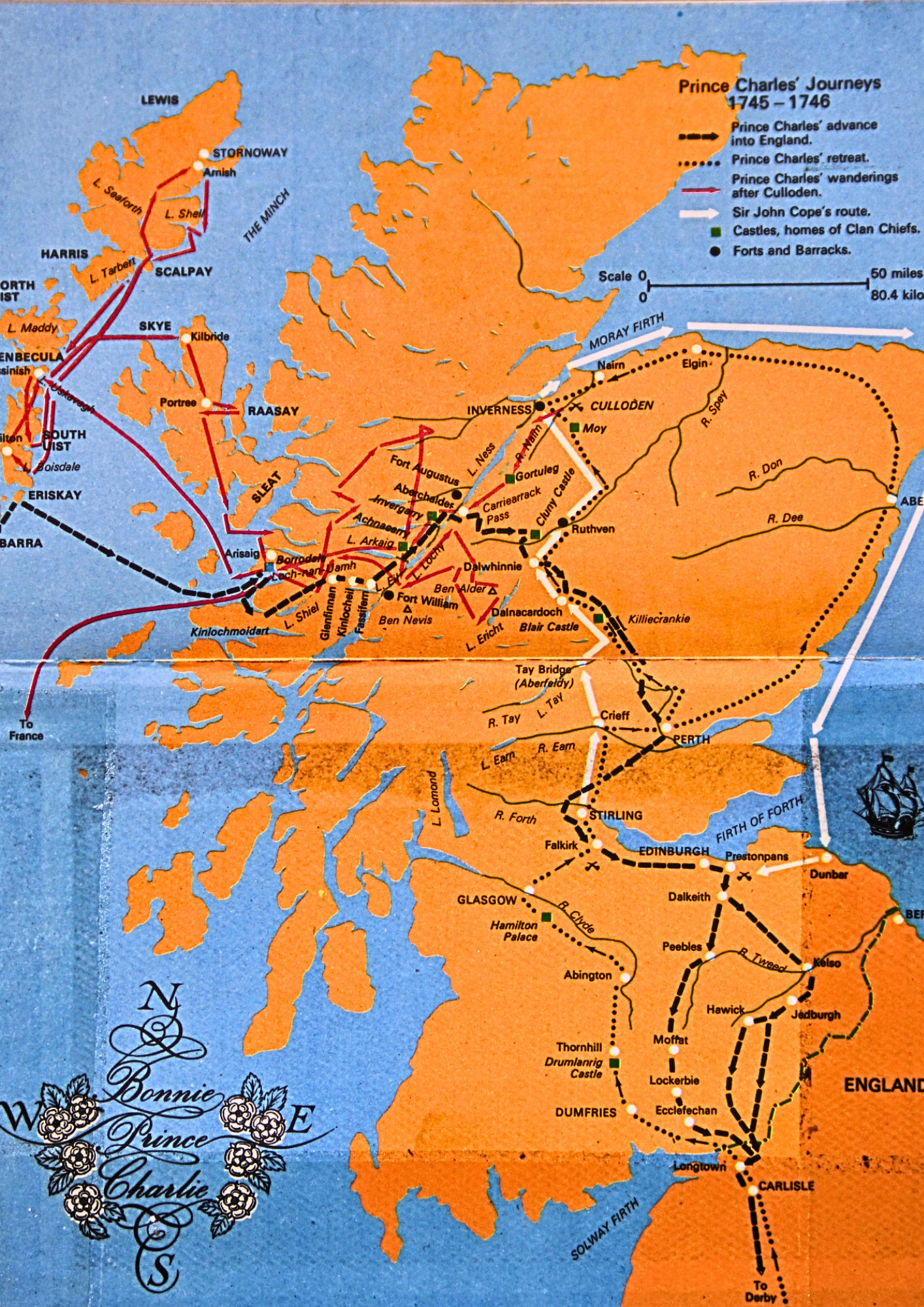
In November, Lord John Drummond arrived from France with 800 Royal Scots, an Irish brigade, and two squadrons of Prince FitzJames’s cavalry. They brought with them important news in the form of letters detailing promises of military aid from France and the withdrawal of Hanoverian troops from Flanders. Full of enthusiasm and optimism, Prince Charles set out at a rapid pace at the head of his army toward England and, on November 15, captured the city of Carlisle, which surrendered just before the siege began. The incredible speed of the march and the Highlanders’ diversionary tactics misled the government commander (General Wade), who, believing they were heading for Newcastle, marched east toward Kelso, only for them to then make a sharp turn west toward the English-Scottish border. The march through England from November 20 to December 3 took place in two separate divisions; in this way, they sought to outwit the government forces, marching through Penrith, Kendal, Lancaster, Preston, and Manchester. The Highlanders quickly covered the difficult winter terrain, moving through harsh, hostile territory. Lord George Murray outmaneuvered Cumberland with a clever move, suggesting a false route and thereby opening the way to Derby.
Jacobites army reached Derby on December 4, 1745—just 130 miles from London—and was reinforced by another unit of 300 recruits under Colonel Francis Townley. The combined government forces of Wade and Cumberland numbered 24,000—quite a large number compared to the Jacobite forces—but they were a considerable distance behind and moving much more slowly. Now, a much smaller army stood between Prince Charles and St. James’s Palace, where his father was born in 1688 as a Catholic heir, thus marking the beginning of William of Orange’s invasion of England.
The English capital began to panic, knowing that the Prince and the Jacobites were in Derby with the intention of taking London from the north, while a French attack was coming from the south. Fielding wrote that the threat from the Highlands “caused a fear that was hard to believe”; Walpole said, “Never has a city been so gloomy… I still fear the rebels beyond measure.” Meanwhile, the Bank of England faced a panic-driven flight of capital, which it tried to stem by paying out cash in the form of red-hot sixpences. At the same time, London Jacobites raised a total of £10,000. Posters promoting the House of Stuart began to appear on the streets. Even the Duke of Newcastle began to seriously consider issuing a declaration against the Hanoverian rule in favor of King James. During the panic, he ordered the ships to be loaded with his valuables and kept on the Thames in case he had to flee to the continent.
WAR COUNCIL IN THE DERBY
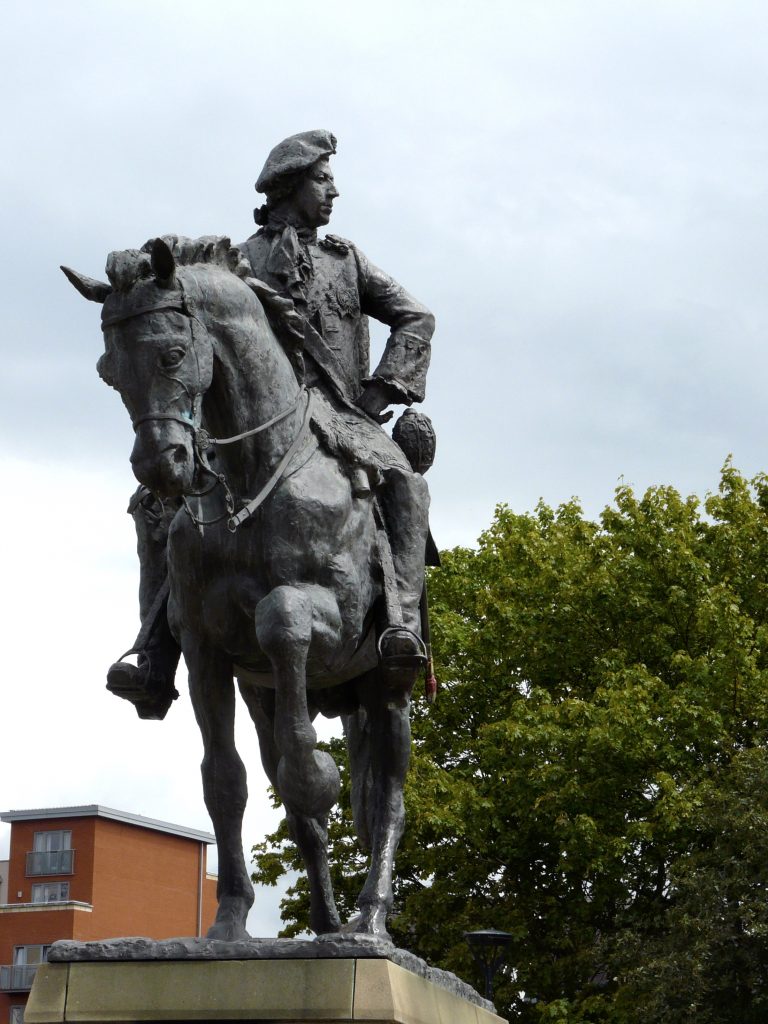
And in light of all these circumstances, Lord George Murray convened a council of war in Derby, the consequences of which would remain unforgettable for the rest of Prince Charles’s life—and, I dare say, for all of Britain. The prince could not believe his ears. Throughout the day, leaders and commanders argued that, in the absence of support from the English Jacobites—who had failed to show up—Charles’s army should carry out a pragmatic retreat to Scotland and join forces with Lords Strathallan and Drummond’s troops, numbering nearly 4,000 soldiers, in Perth. The council was largely unaware of the panic in London and the meticulous preparations that—had the fighting shifted to the English capital—would have been set in motion and, regardless of the outcome, could only have further turned the situation against the Prince. In reality, most of the council felt isolated, vulnerable, and deep within enemy territory. The Prince was utterly opposed to the idea, realizing that a retreat could be nothing less than a shameful defeat that would destroy morale and undermine the winning side’s appeal. Prince Charles’s first words to Lord George Murray were: “Retire, Lord George? But the clans told me something entirely different and assured me that everyone is determined to fight to the death!” The war council that day concluded with the decision to return to the Highlands. For the rest of his life, the prince felt betrayed by his allies, which would later lead to a lack of trust, the trauma of betrayal, and such profound disappointment that it would leave a mark on the health and psyche of the protagonist of this fascinating story.
After the retreat from Derby, everything changed. As we know, on October 24, the Treaty of Fontainebleau was signed between the Stuarts and d’Argenson, in which France pledged military aid. However, before arriving in Derby, Charles received a message from his younger brother that King Louis XV would try to send aid just before December 20. However, the situation was more complicated, and I believe that not everyone on the French side wanted this aid to materialize. News of the retreat, Minister Richelieu’s opposition to the invasion, and the blockade by the English fleet led to the decision not to send aid across the Channel to England. Analyses later conducted by Dr. Christopher Duffy regarding the decision to retreat and not to attack London revealed this to be a strategic error that ultimately led to defeat. However, the entire retreat operation turned out to be quite well planned by Lord George Murray, during which the Scots attacked Cumberland’s troops, slowing their pursuit and buying valuable time for the return to Scotland. On December 26, the Prince arrives in Glasgow, where he stays for about a week and meets a woman named Clementine, the daughter of John Wilkinshaw, who is closely related to the Stuart family. However, women have played a significant role in Prince Charles’s life and have undoubtedly shaped his emotional state and, to some extent, his worldview.
retreat to the Highlands
In the next phase of the Jacobites’ retreat, we see unnecessary and inept attempts to seize Stirling Castle, as well as Prince Charles’s stay at the Patterson house in Bannockburn. The Prince fell ill as a result of the stress he had suffered when he was forced to turn back from Derby, near London. It was here that a woman he had met in Glasgow came to his aid, helping him to regain his strength. However, this period continued to take its toll, leading to constant arguments between Lord George Murray and the Prince over the decision to retreat from Derby. During this time, there was also a brief skirmish with the troops of General Henry Hawley, who had arrived to reinforce the defenders of Stirling Castle. During the Prince’s absence, Lord George Murray commanded the Highlanders, numbering 8,000, and led them to victory at the Battle of Falkirk on 17 January 1745. This battle has been described as more significant than the earlier battle at Prestonpans. Many of General Hawley’s officers were killed, and he himself was forced to retreat to Linlithgow, where, on the other side, casualties were minimal. That same evening, he reportedly wrote a letter to Cumberland in which he spoke of how deeply his heart had been broken – which, according to some, could not have been true, as he had no heart to begin with. At the same time, off the coast of France, his brother Henry was awaiting the departure of the French fleet; this was at the beginning of 1746.
In January 1746, shortly after his victory at the Battle of Falkir, Prince Charles Edward found himself facing the prospect of fighting the Duke of Cumberland at a symbolic location known as Bannockburn. It was symbolic because it was at this very spot in 1314 that his ancestors, King Robert the Bruce and Walter Stuart, had defeated King Edward II’s forces – three times their own size – in the war for independence. These events, which never actually took place, could have provided incredible inspiration for the days to come. However, reality proved harsher for the Highlanders, particularly following their victories. Letters and rumours began to circulate that no help was forthcoming, that there would be no French invasion across the Channel to London, and that Cumberland’s army was formidable. All this results in such a decline in morale and desertions to the north of Scotland that, on 29 January, the commanders, without consulting the prince, suggest a total retreat northwards. All this takes place in such chaos that the artillery is abandoned and the retreat proceeds in utter disarray. There are justified fears that such a scattered army will be unable to re-establish itself at its northern outposts. John Hay of Restarling, informing the Duke of the ‘disappearance of the army in the blink of an eye’, witnessed an incredible outburst of anger directed at Lord George Murray, described in these words: ‘It may well be that victory and defeat will have the same consequences, and that the victors will flee from battle whilst the vanquished will seek it out! Are you suggesting that we should retreat?! How much more will this lift the spirits of your enemy and demoralise your own men?!” In early February, whilst in Crieff, Prince Charles, having assessed the strength of the enemy forces, came to the conclusion that he had undoubtedly been betrayed, and that the retreat ordered by Lord George was no longer as orderly as the one at Derby.
CONTROVErsial AND DIsastrous DECISIONS PRIOR TO THE BATTLE OF CULLODEN
Prince Charles may have been young and inexperienced, but he possessed remarkable intuition and was not afraid of the enemy. However, he knew that the enemy’s morale was rising and, moreover, his cousin from Cumberland (Frederick von Hesse) had arrived by ship at Leith, not far from Edinburgh, with 5,000 German soldiers. In the face of these developments, Charles Edward set off for Inverness and, upon arriving on 19 February, established his headquarters at a house called Culloden. From this central position and the capital of the Highlands, he intended to regain control of Fort William and Fort Augustus, destroy Wigh’s local forces and, most importantly, capture Inverness and as much of the coastline as possible.
Inverness Castle was captured immediately. On 1 March, Fort Augustus surrendered during a siege carried out by Lochiel’s Camerons and the Macdonalds of Keppoch, with the assistance of Drummond’s men. Unfortunately, the siege of Fort William did not come to fruition and they were forced to withdraw on 2 April. During the protracted fighting, they managed to disperse the enemy forces, but due to a lack of supplies and support – which were needed in other parts of Scotland – they had to leave their artillery behind and abandon the siege of Fort William. In late March 1746, as if to add to their misfortune, Lord Reay’s detachment intercepted supplies that had been sent from France to Scotland. A vast quantity of ammunition and equipment, along with £12,000 in coins, was seized on that occasion. In addition, 1,500 men were taken prisoner when Lord Cromartie decided to recapture the supplies from the enemy. This was a staggering loss at the time, leaving a deep mark on the morale of the Jacobite army.
All the operations and troop movements were significant, but from my point of view, 8 April was a pivotal date. You might ask why? It is precisely because on that day, after a month-long halt, the Duke of Cumberland’s army well-equipped, well-fed and, most importantly, well-rested – set out from Aberdeen, in stark contrast to the Prince Charles’s army, reaching Nairn on 14 April. At the same time, the troops who had been marching at a breakneck pace from Lochaber and Sutherland reached the outskirts of Inverness. These were Lochiel’s troops and Glengarry’s men, who were exhausted after their long march and in low spirits. And it was at this very moment in the entire campaign, which had begun in 1745, that events unfolded and decisions were taken that remain baffling to this day and continue to provoke much controversy.
Aware of Cumberland’s approaching army, the commanders and Prince Charles debated the choice of a battlefield. The Prince seemed to possess the genius’s instinct for swift tactics, even though the evidence did not entirely support this. It is thought that desperation led to a disregard for Murray’s reservations regarding the choice of the Drummoisse moor as the battlefield. The flatness of the terrain was perfectly suited to the Hanoverian artillery, whilst the lack of hills made it impossible to carry out the famous highland charge. Consideration was given to using the town as a supporting element, but the Prince wished to leave it untouched. All his supplies were stored there, and it seems there was no other option; although, knowing the terrain outside Inverness and the extent of the woodland there at the time, I believe the site chosen was the worst possible one.
Failed attempt to attack the camp in Nairn
On the night of 15–16 April, an attempt was made to attack the camp of the Duke of Cumberland in Nairn, who was celebrating his 25th birthday. According to Lord Murray’s plan, as he himself claimed, no one would expect our attack at night because everyone would be as drunk as skunks. And everything would have gone smoothly had the plan been implemented immediately; instead, the soldiers scattered in search of food, which resulted in a loss of precious time. Furthermore, no account was taken of the difficult marshy terrain, which further slowed the march, nor of the differences in pace between the various units. Just a few miles from the enemy camp, Murray – who had come up with the idea – gave the order to turn back towards Culloden, without consulting the Prince. It was certain that they would not reach the camp before dawn and the element of surprise would be lost, but the Prince was convinced that it was still worth risking an attack, as the return march would completely exhaust the soldiers – both physically and mentally – who were already collapsing from exhaustion. Just as at Derby, history repeated itself, and Murray was criticised for a decision that was once again regarded as a betrayal in the Prince’s eyes. In the early hours of the morning, the Jacobites were utterly exhausted after their night-time march and extremely hungry. Even then, the arrival of a further 300 men under the command of Fraser of Inveralloch offered little cause for optimism.
At around midday on 16 April, on that memorable day, the two armies faced each other. As if sensing what was about to happen, the weather added to the drama by sending a mix of rain and snow from the sky. On one side stood 9,000 of Cumberland’s soldiers, freshly fed and watered after their birthday celebrations. On the other side were 5,300 of Prince Charles’s highlanders, exhausted, hungry and dejected. To the right of Jakobicka, we see the Atholl Brigade, supported by the Robertsons and Menzies, followed by the Cameron clan of Lochiel at the front, then the Stewarts of Appin, the Frasers, the Mackintoshes, the Fraquharsons, the MacLachlans, the MacLeans, the MacLeods, the Chisholms, and on the left, the fearless MacDonalds of Clanranald, Keppoch and Glengarry. In the second line, we see French troops commanded by Lord Ogilvy and Lewis Gordon, the Duke of Perth, and Lord John Drummond. On the left flank of the second line, we also see Irish pikemen and cavalry led by Lord Strathallan, Pitsligo and Balmerino. And it all began with a single Highlander who marched alone towards the enemy army and, in a desperate yet truly heroic act, sought to shoot the commander, believing that this would prevent bloodshed and spare his kinsmen.