
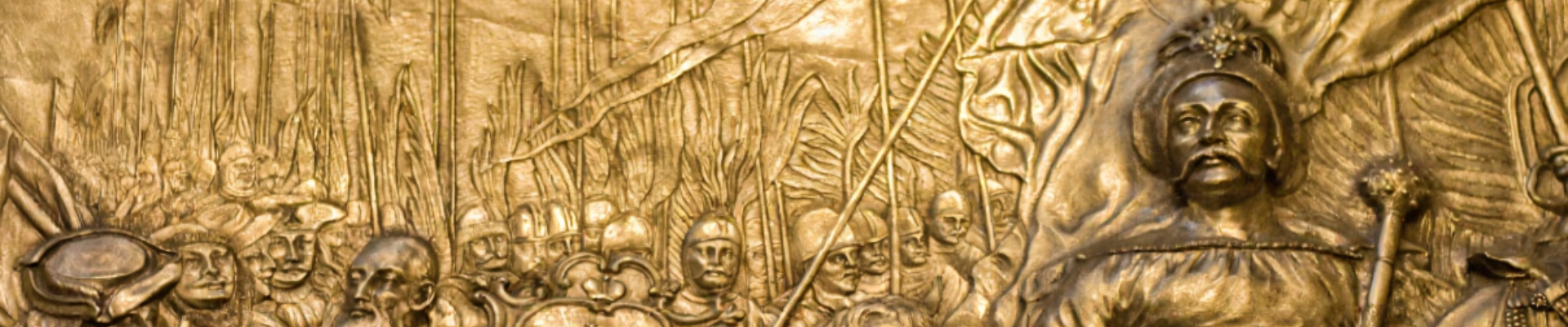
CHRONICLE OF THE LIFE JAN III SOBIESKI
Welcome to the history Review of John III Sobieski. This is the first character description on my website in this format. I believe that learning about history is one thing, but getting to know the people from history is equally important in this process. That is why I have decided to publish biographies of important people on my website. I will try to weave their stories into the true story of the Highlander in such a way that it all comes together. However, I must be honest with you and make you aware that history is confusing and unpredictable, so hold on tight.
Birth – roots – upbringing
Jan III Sobieski was King of Poland and Grand Duke of Lithuania from 1674. He held this position for 22 years, taking office at the age of 45. As I mentioned earlier, in order to understand his personality, we need to look back into the past and examine his roots, which will certainly help us understand more. He was born on 17 July 1626 in the castle in Olesko (today Ukraine, but at that time these lands belonged to the Polish Crown). He died on 17 June 1696 in the Wilanów Palace in Warsaw at the age of 66. I noticed the incredible magic of the numbers six and nine in the dates, which I consider a strange coincidence. We know that his grandfather was Stanisław Żółkiewski of the Lubicz coat of arms. From 1618, hs’s grandfather was the Grand Crown Hetman, holding many titles. He died shortly after the Battle of Cecora in 1620, mortally wounded by the Ottoman-Tatar army, and from this we can already deduce the direction in which the ambitions of the young Jan were shaping up. His mother, Teofilia Zofia-Sobieska, was incredibly brave and possessed extraordinary courage. There are stories in which, despite her young age, she commanded the castle’s defence during the Turkish attack on the castle together with her mother and grandmother. His father, Jakub Sobieski, was a well-known politician and diplomat and held the title of Castellan of Krakow. He made every effort to ensure that the young Jan, the future King of Poland, and his brother Marek Sobieski received a proper education, which is why he was sent by his father to the Krakow Academy (today’s Jagiellonian University). Apparently, he spoke eight languages, not all of them fluently, but still, I have great respect for his linguistic skills. Imagine how precise the parenting instructions were at that time, that they even had to maintain a specific number of baths per month according to the recommendations. One of my brothers became fascinated with the story of his father Jakub, and that is why I want to add that Jan’s father instilled personality in him, passing on the best of himself and showing him how to fight the enemy. Jan Sobieski travelled extensively throughout Europe. He learned about customs and life outside the Polish-Lithuanian Commonwealth, which certainly benefited him in the future. He was not sent there to indulge in debauchery, but to educate himself in military matters. Compared to his contemporaries, Jan III Sobieski was a very well-educated person. Thanks to intensive language learning and travelling, he became a polyglot. After travelling around England, Italy, the Netherlands and of course France, he returned to his homeland at the request of his country. And this is where, in my opinion, Jan’s real life began.
The homeland calls
It is 1648 when the Sobieski brothers return to their homeland and having enlisted in the army as cavalry captains, take command of their own banners and undergo their baptism of fire in the Battle of Zborów. In 1649, Jan takes part in the relief of Zbaraż, where his brother Marek is among the besieged. In 1651, he was wounded in the head in the Battle of Berestechko, but this was fortunate for him, as he did not participate in the next battle at Batoh a year later. It was in this battle that his brother was killed, or rather after the defeat, he was beheaded along with all the prisoners by Bohdan Khmelnytsky. And here, in my opinion, the Tatars once again became his main enemy. After these events, in 1654, he spent some time in Istanbul incognito to improve his language skills and spy on the enemy. I could say that he was a spy of his time. The following year however, he switched sides and fought against the Polish king. For less than a year, from October 1655, he was on the Swedish side and fought for King Charles X Gustav against his own king, John II Casimir. Many believe that this was treason (and they are probably right). My intuition tells me, however, that it was a spy move to spy on the enemy and his military techniques, which were modern for those times.
marysienka jana - master lubomirski - reversal of the Swedish Deluge
In the same year, Jan meets his future wife and beloved, Maria Casimira d’Arquien, but they do not marry until 1665. Apparently, he fell in love with her at first sight, and she reciprocated his feelings, but Jan Zamoyski, who had already been chosen for her by the queen, stood in their way. Unfortunately, in those days she had to obey the queen, especially since she had brought her from France and was dependent on her. Zamoyski was very well-off, not as impetuous as Jan, and had good views that appealed to the queen. Perhaps that is why Jan Sobieski decided to go into the service of the King of Sweden, because he was so in love that he lost his mind knowing that he could not have his beloved Marysieńka.His service to the king does not last forever, nor does his spying, and in 1656 he returns to Czarniecki’s command near Łańcut. The King of Sweden is, of course, furious and orders all his relatives to be hanged wherever possible, while the Polish king, instead of punishing him for serving the enemy, welcomes him with open arms, having no other choice, as he knows that every good warrior is worth his weight in gold. From then on, he came under the command of Jerzy Sebastian Lubomirski, who was his teacher and master of the art of war, and it must be admitted that Lubomirski knew his stuff like no one else in the entire Polish-Lithuanian Commonwealth. He took part in many battles, for which the king promoted him to the rank of Grand Crown Standard-Bearer. To describe the course of all the battles, I would have to write a book, which I do not have time for, because I have to go hiking in the mountains, so I will recall some of them: the Battle of Warka (7 April 1656), the Attack on Toruń (19 April 1656), and the Battle of Warsaw (28 July 1656). In October 1658, he recaptured Toruń as a royal colonel. All these military manoeuvres in which he took part were directed against the Swedes, who were eventually pushed out of the Polish-Lithuanian Commonwealth, ending a period known as the Swedish Deluge, which brought incredible losses to the country.
A turbulent history before the throne
In 1659, he became a representative at the Lublin regional council, and a year later, he became a town elder in Stryj (then Ukraine). He financed the Dragonia cavalry banner from his own funds and on 16 September distinguished himself in the battle of Lubar against the Russian army. On 17 October, he signed agreements with the Cossacks, which brought about a fairly good understanding. It must be admitted that Jan Sobieski, not yet king, was very busy and active on many fronts. In 1663, he set off with King Jan Kazimierz to Russia to recapture the territories on the Dnieper River.
However, Jan Sobieski’s history is not all rosy, as there are many moments in which it is not clear which side he was on. One such moment is the most difficult and tragic period of the Polish-Lithuanian Commonwealth, when the country was ravaged by wars on all sides, namely the Khmelnytsky Uprising, the Swedish invasion and the Russian attack on the lands of present-day Ukraine, including Kiev. In addition, there was a dispute with Lubomirski, who formed a confederation in opposition to the policies of King Jan Kazimierz. Jan Kazimierz wanted to introduce the principle of VIVENTE REGE, translated as ‘during the King’s lifetime’, which meant that the king would be appointed by the incumbent and the free election would be abolished. As a result, this provokes a rebellion and a battle ensues between Jan Sobieski, who sides with King Jan Kazimierz, and his teacher Sebastian Lubomirski. You may ask why Jan Sobieski took the King’s side. As I mentioned earlier, King Jan Kazimierz’s wife, Ludwika Maria Gonzaga de Nevres, came from France, and it was she who brought Marie D’Arqie, or Marysieńka, from France. She was the one Sobieski fell in love with at first sight, and after the death of Jan Zamoyski, he married her. He probably had a difficult choice to make, but in the end he remained loyal to his wife and the king and fought against his master at Mątwy in 1666, where he suffered a crushing defeat, losing his best horses, 1,500 of them, called Dragons. I assure you that the DRAGON horses will feature in my story very soon. This is undoubtedly a very sad period in Polish history, in which Poles slaughtered each other in the name of ideas and pro-French politics, in which Louis XIV wanted to establish his candidate on the Polish throne. After these inglorious events, an agreement is reached and VIVENTE REGE does not come into force, but Lubomirski is stripped of all his titles and exiled from the crown. Jan Sobieski was fortunate in this situation and acquired the titles of his master, becoming Grand Crown Hetman, i.e. the second most important person in the state and commander-in-chief of the army of the Polish-Lithuanian Commonwealth. In 1668, King John II Casimir abdicated and left Jan with missions related to pro-French policy. This attitude and excessive attachment to France led to a conflict with the newly elected King Michael Korybut Wiśniowiecki. And here I must admit that, from my point of view, Jan Sobieski behaved unworthily of a future king and, instead of focusing his attention on helping, he concentrated his efforts on vetoing the decisions of the king and the Sejm, which led to the division of Poland at that time into two confederations: the pro-French Sobieski and the pro-court Wiśniowiecki. Despite this turmoil, or rather chaos, Jan regains his composure and memory of his ancestors and is able to gather the strength and resources to crush the Turks in the famous Battle of Chocim on 11 November 1673. This victory and the death of Wiśniowiecki just hours before the battle paved the way for him to the crown.
Jan III Sobieski elected king
On a sunny day in May 1674, he was elected King of Poland, but in the face of a war requiring his intervention, his coronation was postponed until 2 February 1676. The situation of Jan III Sobieski, already king, did not improve at all, and further problems added to his worries. He became king of one of the largest and most populous countries in Europe at the time (see map). This country, the Polish-Lithuanian Commonwealth, was devastated by internal affairs and wars with its neighbours on all sides. The new king Sobieski faced a multitude of questions and tasks. He must have wondered which direction to take. Should he turn south and defeat the Turks, or should he direct his military forces eastward and take back the land (Siewierszczyzna, Czernichów, Szczyzna and eastern Ukraine, including Kiev)? Or perhaps he should head for the Duchy of Prussia, which was politically linked to Brandenburg and had gained independence during the Swedish Deluge. John drew attention to this direction, which was strategically important for the future of the Commonwealth, and in 1674, while repelling the Turkish armies that were still attacking the Commonwealth with his brilliantly conducted campaigns. In secret diplomacy in Jaworów, he made arrangements with Louis XIV, King of France, and Sweden to attack Brandenburg and Prussia. And everything would have been fine with this move, had it not been for the fact that Sobieski wanted to seize these lands for himself, for his son, and not for the country. The Polish nobility was, of course, opposed to this idea because the lands were supposed to belong to the Republic and not to the King. In addition, the ruler of Brandenburg formed an alliance with France, and Prussia defeated the Swedes. Sobieski’s plans for his own campaign against Prussia were opposed to such an extent that they wanted to dethrone him and elect Charles V of Lorraine, the same man who later commanded in the Battle of Vienna.
The greatest victory
As we know from history, which I have also described here on my highlander website, it was a time when the Ottoman Empire was considering an attack, but was not entirely sure whether to strike Poland or the Holy Roman Empire. Whether he wanted to or not, John III Sobieski signed an alliance in March 1683 with Emperor Leopold I for mutual assistance in the event of a Turkish attack. Meanwhile, royal spies discovered the Ottoman Empire’s preparations for a military campaign. Sobieski believed that LVIV or KRAKOW might be attacked, so he called for a general conscription into the army.
However, he achieved the greatest success of his life in the Battle of Vienna, which you can read about in my extensive article here. The Pope and other dignitaries hailed him as the ‘Savior of Vienna and Western European Civilisation’. In a letter to his wife Marysieńka, he wrote: “All the simple people kissed my hands, feet and robes, saying, “Oh, let us kiss such a valiant hand”. However, the war with the Turks did not end immediately after Vienna. Sobieski continued his skirmishes with the Turks, such as in the Battle of Parkany on 7–9 October. Despite his earlier victories, Sobieski did not receive any major privileges, although he should have. To be honest, the Holy League, to which he belonged, outplayed him and Poland politically. He was not even given a monument on Kahlenberg, from where he saved Vienna. To sum up his biography, I will say that he was an incredible man with great ambitions, instilled with great values by his fathers. As a Highlander, reading his story took me on an incredible journey, sometimes with mixed feelings as to whether he was really acting in the best interests of his country, but with the Battle of Vienna, he proved that he was, so now I have no doubts. I will definitely return to his story, as I want to pass it on. History lovers, I almost forgot the fact that Jan III Sobieski was the great-grandfather of Prince Bonnie Charles, who started my adventure with the True Hi-Stories of the Highlander. Respect.