
Father, Brother Henry—The Women in the Prince's Life
Many may think that the story of Prince Charles Edward ends with his escape from Scotland to France. However, on many pages of the books, this turbulent life story is only just entering its next phase. Let me tell you about the events and matters that I consider significant—those that feature on the historical timeline of Bonnie Charles. This will also serve as a general overview of the figure.
I’ll start with a matter that’s been really bothering me—one involving his brother Henry and his father, James VIII & II. As far as I know, their relationship was never the best—well, maybe only at the very beginning, until the prince turned five. Why five? Because when he was five, he welcomed his brother into the world. It’s clear from accounts that his father favored Henry and had no affection for Prince Charles. Fearing that his eldest son would surpass him, James favored his younger son Henry (the Duke of York), and in the future, the two often collaborated to the detriment of Prince Bonnie Charles. This does not mean that the Prince was without faults; in any case, it led to a total lack of trust and a sense of betrayal. For example, when the Prince was ill in Bouillon, James—who had somewhat recovered from the shock of the mission in Lumisden—decided to attack his son on the two most sensitive issues: religion and his girlfriend, Clementine. In any case, women played a huge role in Charles Edward’s life, and I believe the Prince was fascinated by them, but due to his tendency toward alcohol and the stresses of life, he became overly aggressive and even beat his lovers. I cannot say exactly how many affairs and lovers he had, but undoubtedly quite a few, and they remained in his psyche until the very end. The prince’s love stories are worthy of a separate article—and perhaps even a book. It is certainly worth mentioning Luise zu Stolberg-Gerden, Clementine Wilkinshaw—with whom he had a daughter named Charlotte and with whom he was involved for a very long time—perhaps the longest of all—and Marie Louise de Bouillon, Duchess of Talmon. In January 1746, at Bannockburn, Clementina Wilkinshaw promised him that if his grand political ambitions came to naught and he ever needed her, she would be completely obedient to him. Six years later, guided by purely practical considerations, the prince took advantage of her promise. This woman was the tenth daughter of John Walkinshaw of Barrowfield (b. 1671), a man who had taken part in the 1715 uprising. When Clementina Sobieska was detained in Innsbruck, John Walkinshaw was sent to lodge a protest with the emperor. Later, a elaborate legend arose that Clementina Walkinshaw was supposedly named after Charles Edward’s mother. We must not forget a woman named Flora MacDonald, who sacrificed everything—even risking her life—to help with the escape.
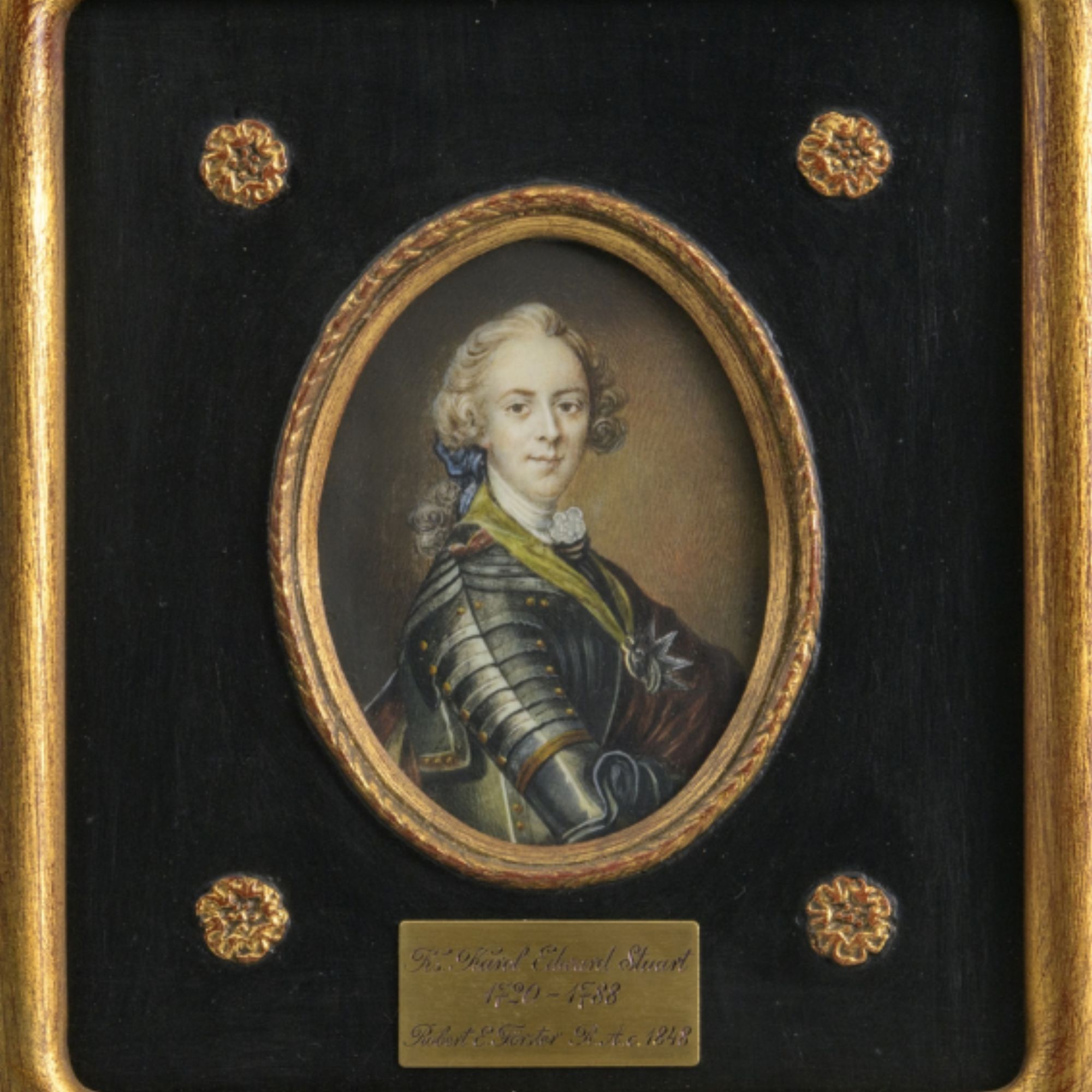
Arrest by the French and the prince's interest in America
While reading *The Story of a Young Pretender*, I came across references to America, and in a way, that piqued my interest. I was intrigued by the fact that in 1775, the residents of Boston sent him an invitation to become the symbolic head of the provisional American government. However, no clear evidence of this document has survived, but Dutens, who was a reliable reporter, confirms this story, as do English sources. According to one account, the prince arrived secretly in Milford Haven, Wales, to board a ship bound for the New World. This was certainly the source of the rumor that Charles was on his way in 1775. There is no doubt that the prince took a keen interest in the American War. Reportedly, the prince asked his agent, Father Cowley of the Benedictine Order, for a detailed map of North America so that he could follow military operations, as well as for maps and a historical summary of the entire American continent north of Panama. Bonnie Prince Charlie wanted to restore the Stuarts’ good name at all costs, even though he knew that all options had already been exhausted.
In 1748, he risked remaining in Paris after having previously been exiled from France. This decision resulted in his arrest, during which the prince was convinced of treason and conspiracy on the part of France on an unprecedented scale. While being transported to prison in the Faubourg St. Antoine district, he exclaimed: “I thought I was among the French, but I see that English guineas have turned you into Hanoverians.” I still wonder?! How could he have been, all those long years, a prince without a throne, a member of the royal family without a kingdom, a man who supposedly derived his rights from God—how long could he have stayed motivated? Especially since he had no support from his father, and it was precisely this lack of authority that led him to become paranoid about exaggerated betrayal. Looking at this figure from the perspective of time, I think he was lost in his era and would have made an excellent agent in the 21st century. Back in the 18th century, he went by many names. These names include: Mr. Benn, Mr. Douglas, Dumont, Cartouche, Wild Man, Mr. Thompson—these are just some of the aliases the prince used during the first five years of his life in hiding in “imaginary space” (to use one of his own terms). This was not merely a matter of ordinary caution. All in all, these disguises and aliases point, on the one hand, to his uniqueness and, on the other, to a lack of identity caused by constant flight and pursuit.
elibank conspiracy , conversion to Protestantism and Famous Sobieski Jewels
His maxims, which he likely wrote down on September 22 after observing the aurora borealis, are well known. These maxims are: (1) If there is a Being, there is also destiny. (2) One should never judge others based on oneself. (3) Never reveal a secret to a weak person, for it may terrify them and lead them to use it against you. These principles will remain in my memory, and so will this story, for as you know, I am guided by the idea that history teaches us, and through it we come to know ourselves better on this path toward the future. I don’t know if you’re aware, but the prince apparently never gave up on his quest to regain the crown and made numerous attempts even after the Battle of Culloden. One such attempt was known as the “Elibank Conspiracy,” which began with a series of meetings in Paris. In reality, the so-called Elibank Conspiracy is a collective term encompassing a whole range of very diverse undertakings that were considered and rejected between 1751 and 1753. After many detailed discussions led by Marischal regarding the appropriate meeting place, the conspirators got down to business. Among those involved from the very beginning were Sir John Graeme, Goring, Lochgarry, and Alexander Murray of Elibank.
The next attempt seems to have been controversial and, to many, ill-conceived, but it caused the Holy See to view him unfavorably. During a ceremony at the Anglican church on the Strand, Bonnie Charlie formally renounced the faith of his ancestors because of his contempt for organized religion. Charles Edward did not realize what a sensation this change of religion would ultimately cause. As an intelligent man, he regarded the dogmas of Christianity as either nonsense or patently absurd. He did not realize that for many people, religion was still a matter of life and death. Charles Edward appeared to be a religious renegade, a twice-apostate. Could one really expect him to be a good Catholic monarch, and if not, did that not undermine the very foundation of Stoppani’s argument—that the Vatican’s credibility depended on the recognition of Charles Edward? After three years of fruitless efforts and following sincere assurances from the new pope, Charles came to terms with the fact that he would never win this battle. It was agreed that the prince would appear in public in Rome as the Baron of Renfrew; the Vatican would endeavor to settle social matters.
It is impossible to avoid the topic of the Sobieski family’s origins and related matters. These connections accompanied the prince throughout his life, even in its later stages. The matter was linked to the Polish Confederation—which encompassed Lithuania, Greater Poland, and Bar—that opposed Stanisław II and was secretly supported by France in its efforts to declare the Polish throne vacant and drive out the Russians. This “Bar Confederation” also had a religious dimension: it opposed the attempts of “dissidents” (Orthodox Christians and Protestants) to secure religious tolerance in Poland. It was widely believed that Charles Edward was traveling to Poland to lead the confederates; rumors that he would join the dissidents were less plausible. Events that had been of purely personal significance—such as Karol Edward’s conversations with Princess Jabłonowska in 1770 regarding Sobieski’s money—were now interpreted in an ominous light, as part of some grand Polish conspiracy. His brother Henryk, in 1786, had the great Sobieski ruby set into his bishop’s miter. In 1796, he did exactly what he had so strongly criticized his brother for allegedly wanting to do: he sold a ruby from the collection, described as “as large as a pigeon’s egg,” for about 60,000 pounds. To make up for his harsh treatment of his brother, Cardinal York unhesitatingly offered him the rest of the Sobieski jewels, which was no sacrifice at all for Henryk.
A Summary of the Prince's Life Story
Prince Bonnie Charles is a figure who cannot be judged unequivocally, and I believe everyone should take a closer look at him and reflect deeply on his motives. He possessed traits that, combined with the world of his time and the problems entrusted to him, created an explosive mix. To many, he is merely an obsessive advocate for the Stuart cause, while to others, he is a romantic hero embodying an ideal that continues to inspire many in their pursuit of a goal despite constant setbacks. Many claim that he is shrouded in the aura of the enduring memory of the 1745 uprising, and they are likely correct. Thanks to the recent resurgence of research on the Jacobites, we can finally appreciate the mortal threat to the regime that the 1745 uprising posed. They called him a troublemaker, an alcoholic, and a womanizer, but I believe that the mind that conceived and carried out the 1745 uprising was more than just that of a troublemaker. It was the mind of a man with true strategic acumen. In some respects, he seemed to be ahead of his time. He had an intuitive knack for commanding cavalry and possessed incredible charisma that no one could resist. He understood that great feats in human history were “impossible” until someone actually accomplished them.
It is no coincidence that the prince was an excellent hunter. He thought of waging war in terms of hunting: speed of movement, lightning-fast attacks, conservation of strength, and respect for the vanquished. There is no denying that his arrival in Scotland served as a catalyst for action and reignited the aspirations of many in their quest to overthrow the oppressive Hanoverian rule. However, we must not lose sight of the bigger picture, and that is precisely why it is important to note that, despite his relentless efforts, the Prince did not achieve his goal. For this reason, among others, he sought solace in a bottle of his beloved whiskey or brandy. At the lowest point of his career, the Prince was despondent, depressed, paranoid, an alcoholic, lonely, and aggressive. He suffered from chronic asthma and edema. Less than thirty years separated the peak of his career from its downfall. Such a precipitous decline suggests a deeply unbalanced personality, devoid of any middle ground in mental functioning. The old perception of the prince as a man incapable of coping with failure due to mental weakness does not stand up to critical analysis. A careful examination of Charles Edward’s character reveals that he was highly intelligent, even if his intelligence was often difficult to understand. No one needed success as desperately as Bonnie Charlie. It would seem that he was unable to find a middle ground and always got himself into even greater trouble. I believe this was reflected in the trauma he suffered during his youth, and as a result of the stress caused by his setbacks, he made poor or ill-considered decisions. This trauma intensified after his mother’s death, and reportedly, at that time, it was a mark that remained etched in the prince’s memory forever. After 1766, the prince’s situation took on yet another dimension. From Prince of Wales and then king, Charles Edward became—as a result of the pope’s refusal to recognize his title—the very embodiment of absurdity: a pretender to the throne. No one who fails to understand the alienating effect of such a status on a person whose identity was already precarious stands a chance of understanding Charles Edward Stuart. The prince was a significant historical figure for less than a year—that is, for the duration of the Jacobite Rising of 1745.
And yet he became one of history’s legendary figures. How can this be explained? From my perspective, what resonated with people was the fact that, despite all these setbacks, the Prince steadfastly pursued the liberation of Scotland, England, and Ireland. The facts clearly point to failure, but in my eyes, he demonstrated great spirit by persisting relentlessly, even though there wasn’t the slightest chance of success. After his death, Charles Edward became the focal point of many converging themes: Scottish nationalism, romantic nostalgia for a lost paradise, and even what George Borrow called “the frenzy of nobility.” Robert Burns, Sir Walter Scott, and even George IV were key figures in shaping the legend of “Bonnie Prince Charlie.” The story of this figure will stay with me forever, and I must admit that despite his defeat at Culloden and his difficult, fascinating life, I have great respect for him because of the positive qualities he sought to bring to this world.
P.S. On my “Highlander12.com” website, you’ll find related stories of battles, skirmishes, and places associated with Edward Louis John Casimir Silvester Severino Maria.