
INTRODUCTION
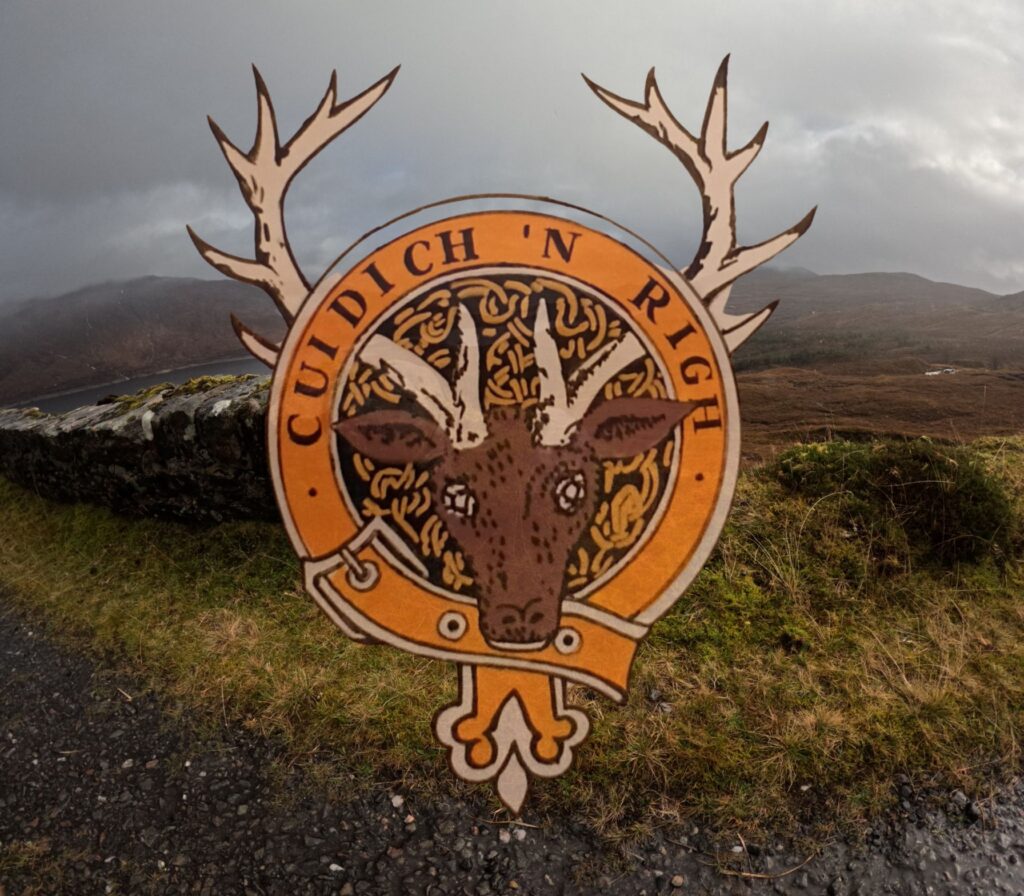
It is 12 o’clock: 18, and the rain outside is pounding heavily on the windowsill, which seems to be saying that it has had enough of this water falling from the clouds, but it is no use because the clouds are hanging so thickly over the ground that they will certainly remain part of the landscape of the mountain valley for many days to come, where a highlander, sitting comfortably in his armchair, has decided to write another interesting story, which dates back to the XIII century and inspired me to such an extent that I want to inspire you with it too. One day, looking at the emblem hanging on the wall depicting a deer in the centre and the inscription ‘Cuidich ‘n Righ’, I began to wonder what it might mean, and I knew then that I would take a closer look at it someday. As the days passed, which I count as written history, I decided that this emblem, which translates as ‘Help for the King’, would be included in my true stories. not everything in this episode will be true, as I will use legends, but as they say, there is a grain of truth in every legend, and it is this grain of truth that I will try to find.
WHERE DID THE MOTTO ‘HELP THE KING’ COME FROM?
To understand a little more, let us go back to the 13th century during the reign of Alexander II. At that time, chaos reigned in the western Highlands and Islands, where high-ranking chieftains had become so powerful and hungry for power that even the king had incredible problems subjugating them. Therefore, on a rainy day, as is usually the case in these lands, the King decided to take a risk and force the rulers to submit, so in 1249, he set out with the mighty force of his army towards the island of Kerrera, where he unfortunately died, leaving his son with the entire burden and responsibility of ruling, and it should be noted that Alexander III was only nine years old at the time.
Alexander III , COLIN FITZGERALD AND BATTLE VS Haakon
Less than ten years later, when the king had come of age, a meeting took place between him and Colin Fitzgerald, or Fitz John, Fitz John was apparently exiled from Ireland after a battle between families and sought refuge at the Scottish court. The king welcomed him warmly and confirmed his skills, having heard about them in many stories.
At the same time, King Alexander III was preparing for a mighty clash with King Haakon IV Haakonson of Norway, who landed on the coast of Scotland, more precisely in Ayrshire, on 2 October 1262. Two days later, two powerful armies clashed at Largs. King Alexander III commanded an army of 1,500 knights who rode Spanish blood horses and were clad in full armour. They were accompanied by well-armed infantry armed with spears, bows and arrows. This bloody battle began with an attack by the Scots. Unfortunately, I will not describe the entire course of the battle, although I find it very interesting. I certainly think that this is a story for another episode, and as you know, in this one we are looking for the case related to motto ‘Aid the King’. I will only reveal that King Haakon and King Alexander clashed in the centre, fighting fiercely against each other. This bloody battle ended in defeat for the Norwegian king, who left between sixteen and twenty-four thousand of his supporters on the battlefield, according to various reports, while Scottish losses are estimated at around five thousand. Among the most distinguished warriors who took part in this great and decisive victory for the Scots, under the direct supervision of their brave king, was, it is said, Colin Fitzgerald, who is mentioned in the Icolmkill Records as “Callenus peregrinus Hibernus nobilis ex familia Geraldinorum’ who was expelled from Hibernia the following year, was kindly accepted by the kingdom and remained here until the court, and fought valiantly in the aforementioned battle.’ In other words: ‘Colin, an Irish newcomer and nobleman from the Geraldine family, who was expelled from Ireland the previous year and well received by the king, remained at court until then and fought bravely in the aforementioned battle.’ Thanks to the victory and the defeat of Haakon of Norway, King Alexander III sent troops to secure the Western Highlands and Islands and to restrain the local chieftains. According to proponents of the Irish origin theory, among the commanders sent to lead the western garrisons was Colin Fitzgerald, who, under the patronage of Walter Stewart, Earl of Menteith, settled in the administration of Ellandonnan Castle, a well-known Mackenzie stronghold in Kintail, which you can learn more about by searching my website for the story of the amazing island of Eilean Donan, located at the confluence of Lochalsh, Loch Duich and Loch Long. Apparently, Colin’s influence extended over a wide area to such an extent that he was said to be the governor. Staying in Kintail and holding a high position, it was probably not difficult and did not take long for Colin to find a wife in the form of the daughter of Mac Mhathoin, heir to half of Kintail. The other half of Kintail belonged to O’Beolan, one of whose chieftains, Ferchair, was made Earl of Ross, and his lands were given to Cailean Fitzgerald. As proven by irrefutable public documents that still exist, these identical lands did indeed exist, with the difference that they were once exchanged with a relative for lands in Buchan, which for two centuries after the Battle of Largs belonged continuously to the Earls of Ross, descendants of Ferchair or Farquhar. These land grants and events after the battle from the king clearly prove that Cailean, or Colin, must have rendered exceptional service to the king. This is confirmed by a document issued in Kincardine in 1266, which states: “Alexander, by the grace of God, King of Scots, sends greetings to all honest people throughout his dominion, both clergy and laity: Let it be known now and in the future that I, for the faithful service rendered to me by Colin of Ireland, both in war and in peace, have given, and hereby grant to the said Colin and his successors, the lands of Kintail, which shall be held by us in free barony, with the right to render foreign service and allegiance.
We come to the moment when legend and motto ” CUIDICH ‘N RIGH” meet in a place better known as Kincardine on the River Dee, where Alexander, while hunting in the forest, came face to face with a charging stag being chased by dogs. Cailean Fitzgerald, accompanying the royal retinue, stepped between the enraged animal and His Majesty with dignity and shot it in the forehead with an arrow.{By the way, why so many sources refer to an arrow when the image shows a spear?} The King, in gratitude for Colin’s royal favour, immediately issued him with a diploma, granting him a coat of arms: a mighty stag’s head, bleeding from the forehead where the arrow pierced it, on an azure field, supported by two greyhounds. This whole incident of the hunt and Colin Fitzgerald’s heroic rescue of Alexander III was painted by West for ‘The Last of the Seaforths’ in one of his great paintings, for which he reportedly received £800, which was quite a lot of money at the time.
FACTS-DR SKENE- Colin in the legend
It would seem that looking at the coat of arms with the motto “HELP the King” and this magnificent painting, the matter is solved and we all know the truth about ‘Cuidich N righ’ were it not for the fact that Dr Skene, the most learned and accurate of all historians from the Highlands, who considers the privilege to be forged and absolutely worthless as proof of the clan’s descent from the Fitzgeralds. So did Colin Fitzgerald not own land granted by the King and, therefore, could not defend it in the Mar forest by the River Dee?
It is difficult to answer this question because I am not a historian, but just an ordinary Highlander who is interested in history. However, it is puzzling what the true history of the Mackenzies’ origins might have been, given that their Gaelic origins were completely refuted by the 1450 manuscript, which has so often been used as a means of detecting falsehoods regarding the foreign origins of other clans. I get the impression, and I think rightly so, that by looking at the history of the coat of arms with the twelve-point stag’s head and the motto ‘Help for the King’, I am discovering more and more about the history of the MacKenzies, which was not entirely my intention – but well, the new history connects with the other to form a whole. As I understand it, throughout this entire period – two hundred years – there is no trace of Colin Fitzgerald or any of his descendants as lords of the lands of Kintail within the meaning of Alexander III‘s alleged privilege of 1266. Throughout this time, they owned the lands from and as direct vassals of their relatives, the Earls of Ross, who in fact held the position of vassals of the Crown, which, according to supporters of Fitzgerald’s theory, if this theory were true, would belong to Colin and his descendants. My instinct tells me that this beautiful legend of Colin Fitzgerald defeating the stag and saving the king’s life was perfectly tailored to the realities of the time, probably to bring the family members closer to serving and devoting themselves to the king. This is supported by the fact that not a single man named Colin has been found. neither among the chiefs nor among the clan members from their first appearance in history until Colin Cam Mackenzie XI of Kintail, who ascended the throne in June 1568 – three hundred years after the alleged date of the alleged privilege of granting the title to Colin Fitzgerald. This whole affair is incredibly interesting and noteworthy, as there are many threads involved, and I will certainly return to this family in the future, whose history is extremely complicated but very interesting for this region of Scotland.
At this point, I would like us to take a closer look at a magnificent painting by Benjamin West. It depicts a legendary scene from Scottish history, in which the life of King Alexander III of Scotland was saved during a hunting expedition from an attack by a stag by Colin Fitzgerald, who, as we now know, was probably a fictional character, which would make this great painting simply a commissioned work. However, as we later learn, “The Death of the Stag” was secured for the Scottish nation in 1987. This happened despite some resistance, as others considered the painting to be an old-fashioned and anachronistic fragment of historical myth. Thanks to Professor Hugh Cheape of Sabhal Mòr Ostaig (University of the Highlands and Islands), the painting now deservedly hangs opposite the magnificent works in the National Gallery of Scotland in Edinburgh, marking a special moment in history when the highlander’s image transformed from that of a rebel to an icon of national identity. Hugh rightly recognized the important role that even myth plays in cultural identity, and saw its key place in British art history. At the turn of the 13th and 19th centuries, Scotland was changing its view of the world. If my instincts are correct, the painting was intended to prolong the memory of the ancient Mackenzie family, which, according to the prophecy of Coinneach Odhar, known as the “Brahan Seer,” was coming to an end.
Francis Humberston MacKenzie,
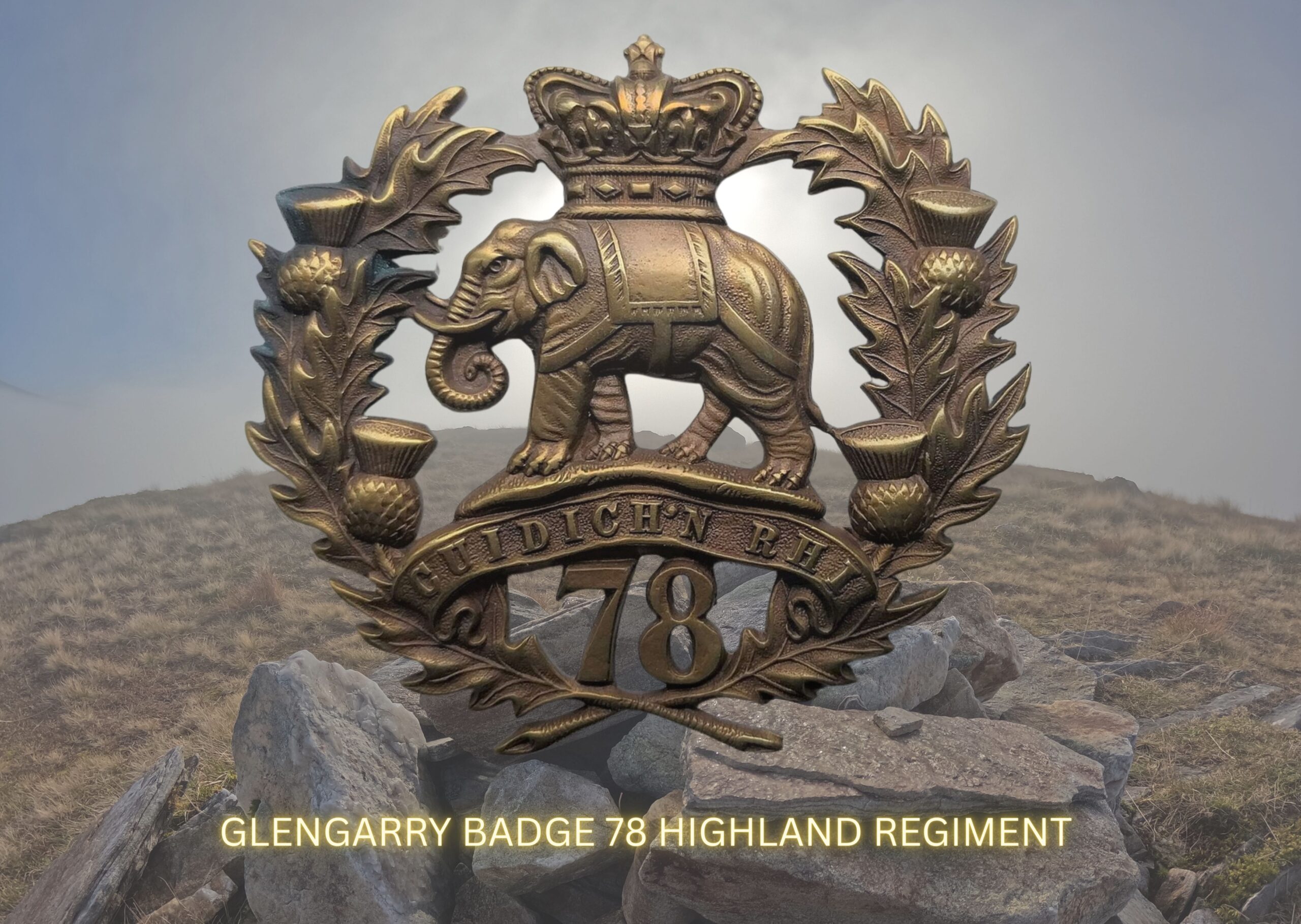
For this reason Baron Seafort and MacKenzie of Kintail. francis spent considerable sums of money to restore his name and family to prominence. In this episode, we will also focus on Francis Humberston MacKenzie, who was Baron Seafort and Mackenzie of Kintail, born in 1754. It was thanks to him that the memory of the MacKenzies was restored, which was particularly important in the period after the Jacobite uprising in 1715. At that time, the very existence of the clans was threatened, and they were persecuted to the last man. All this had only one goal: to completely erase the highlander blood and clan customs. It was he who proposed the creation of a regiment from his estates, initially called the 78th Regiment, later renamed the 72nd Regiment, which I mentioned at the very beginning. The regiment’s emblem was the head of a deer, “Cabar Feidh,” and its motto, “Cuidich N Righ,” or “Help for the King,” which is so important for this episode. The same deer from the picture that inspired me to write this article also appears in the legend of Saint Hubert, the patron saint of hunters and trappers, who, upon seeing a deer with a crucifix between its antlers, converted to Christianity. It seems that the antlers of the royal deer were one of the MacKenzie coats of arms, as well as a slogan and battle cry.
THIS MOTTOS IS A SYMBOL FOR SOLDIERS
Finally, I would like to add that the motto “Aid to the King” was adopted by the 78th Highland Regiment, formed in 1793 by Chief Francis Humberston Mackenzie, mentioned earlier. Subsequently, the 78th Regiment, also known as the Ross-shire Buffs, merged with the 72nd Highland Regiment of the Duke of Albany as part of Childers’ reforms, forming the Seaforth Highlanders (Ross-shire Buffs, The Duke of Albany’s) in 1881. This regiment existed until 1961, when it was incorporated into The Queen’s Own Highlanders {Seaforth and Camerons} regiment and served in this form until 1994. This remarkable motto, from the Gaelic “Cuidich n Righ,” was also adopted by a newly formed group in 1944 in Edinburgh, when The Gordons Highlanders merged with The Highlanders (Seaforth and Camerons) to form The Highlanders (Seaforth, Gordons, Camerons). This motto remained with the soldiers until 2006, when the units became part of a new, multi-battalion Scottish infantry regiment. The motto is also the symbol of a Canadian infantry regiment modeled on the Seaforth Highlanders badge of the British Army.
CONCLUSIONS AND RESPECT
It’s amazing how with each new episode of true stories I discover things I had no idea about before. At the very beginning, I thought it would be very short material, but with each day of research, I realize how wrong I was. Thanks to this, I learned about a distillery called Dalmore, which began operations in 1839. It was created by Sir Alexander Matheson and later taken over by the Mackenzie family, who introduced the twelve-pointed Royal Stag coat of arms in 1867. Apparently, since then, every bottle has featured a stag with 12 antlers. It is the same stag that inspired me to start my research. In this episode, it seems to me that everything will be revealed, but is that really the case? Yes and no, because we have learned some incredible things, both true and untrue. We delved into the search for the roots of the Mackenzie family, whose situation is more complicated than it might seem. It is not for me to judge what is true and what is myth. The most important thing is that the memory has survived and the vision for the future that ancestors tried to pass on has reached me, a Highlander, so that I can pass it on. I am convinced that the motto “Cudich N Righ” will remain in my stories for a long time, and you will hear about it again and again. For this reason, I am not closing this story, but leaving it open..