
 ………..Well, history lovers, let’s return to the life of Buddha, or Siddhartha Gautama Shakyamuni, who is an example of effective action on the subject of lasting human “improvement” and development. Buddha was born into a royal family in 560 BCE in southern Nepal, in a town called Lumbini. His family belonged to the Shakya clan of the Gautama lineage. This is where his name comes from: Siddhartha Gautama Shakyamuni. As a prince, he received a comprehensive education. He stood out with his remarkable abilities, such as intelligence, sensitivity, courage, and strength. He grew up in luxury and enjoyed life. For years, care was taken to ensure that the young heir to the throne did not encounter anything unpleasant, and this is where his story really begins, in which we can distinguish five historical stages of his life.
THE MOST IMPORTANT STAGES IN LIFE
Surprisingly, the first stage can already be classified as the stage before birth. Many biographies of Buddha do not begin with his birth in his last life, but with his life millions of years ago, when he first vowed to become a Buddha. According to a well-known version, many eons ago there lived a Brahmin (the highest social class in India) named Sumedha, who realized that life is characterized by suffering and then set out in search of a state beyond death. In his wanderings, he met Dipamakra. Dipankara was a previous Buddha who attained Enlightenment eons prior to Gautama Buddha. This was surprising because I did not know that there were other earlier Buddhas. Sumedha thought that if he practiced Dipamkara’s teachings, he could free himself from future incarnations in this lifetime. However, he came to the conclusion that it would be better to delay his liberation in order to walk the longer path to Buddhahood; as a Buddha, he could lead others across the ocean of suffering to the other shore. Dipamkara stopped in front of Sumedha and predicted that in many eons this yogi would become a Buddha. He also predicted Sumedha’s name in his last life (Gautama) and the names of his parents and main disciples, and described the tree under which the future Buddha would sit on the night of his enlightenment. Over the next eons, the bodhisattva, or enlightened one, renewed his vow in the presence of each of the Buddhas who came after Dipamkara before he himself became the Buddha Shakyamuni. During his lives as a bodhisattva (enlightened one), he accumulated merit (punya) through the practice of 6 (or 10) virtues. After his death as Prince Vessantara, he was born in the Tusita heaven, from where he surveyed the world to locate the right place for his final birth.
BIRTH AND EARLY LIFE
It may soun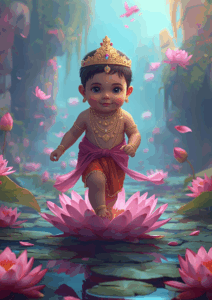 d funny, but Buddha himself decided that he should be born as the son of King Shuddhodana of the Shakya clan, whose capital was Kapilavastu. Shortly thereafter, his mother, Queen Maha Maya, dreamed that a white elephant entered her womb. Ten lunar months later, while walking in the Lumbini Garden, the child emerged from her right hand. He was immediately able to walk and talk (don’t you think that’s amazing?). A lotus flower bloomed under his foot with every step he took, and he announced that this would be his last life. From an early age, he showed amazing abilities and was often found in a state of meditation. There is a record that even the shade did not change during the day to protect him from the sun while he meditated unperturbed. His life was one of luxury; he had many servants, palaces for every season, and a beautiful wife. However, everything changed when he was 26 during his trip outside the walls. He saw an old man, a sick man, a dead body, and a beggar meditating under a tree. This encounter with the real world, which was completely different from his life, changed his way of thinking. After learning about the various afflictions of human life and the existence of those who seek a state beyond them, he decided to leave Kapilavastu under cover of night, leaving his family behind, and set out in search of the truth beyond birth and death.
THE Real Journey began when he entered the forest, where he cut his hair and exchanged his royal robes for the simple clothes of a hunter. From that moment on, he ate whatever was placed in his begging bowl. At the beginning of his journey, he met Bimbisara, the king of Magadha and the ultimate patron of Buddha, who, upon learning that the ascetic was a prince, asked him to share his kingdom. The prince refused, but agreed to return when he attained enlightenment. For the next six years, the prince studied meditation and learned to achieve deep states of blissful concentration. But he quickly equaled the achievements of his teachers and came to the conclusion that, despite their accomplishments, they would be reborn after death. He then joined a group of five ascetics who devoted themselves to practicing extreme forms of self-mortification. The prince also became proficient in their practices, eventually limiting his daily meal to a single pea. He concluded that mortifying the body was not the path to liberation from suffering and rebirth, and accepted a dish of rice and cream from a young woman.
 ENLIGHTENMENT
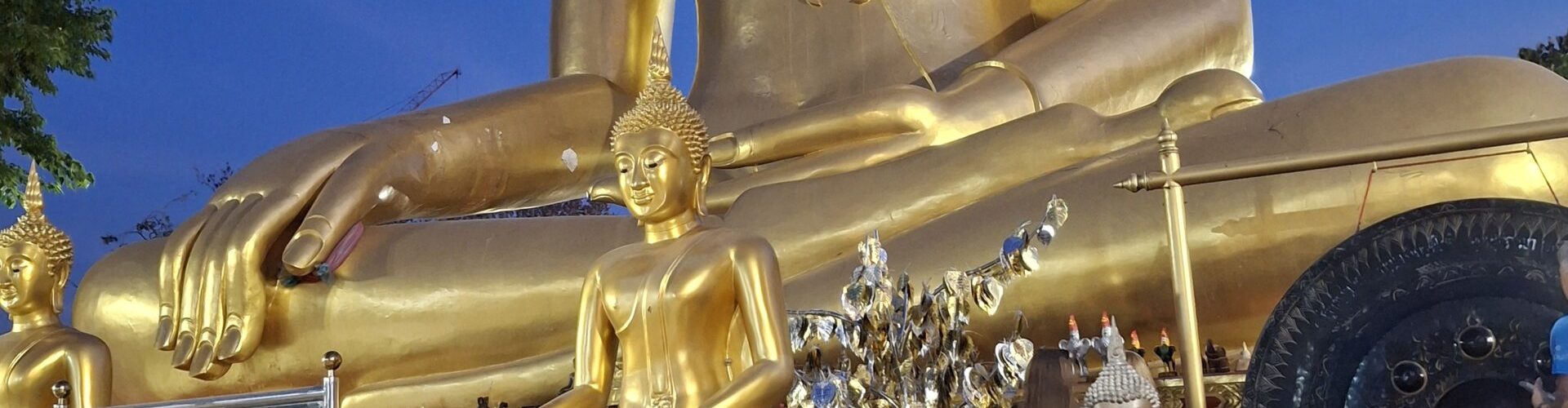
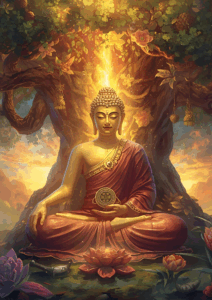
The next historical stage was enlightenment. On the full moon in May, six years after leaving the palace, he meditated until dawn. Mara, the god of desire, who knew that the prince wanted to put an end to desire and thus free himself from Mara’s control, attacked him with wind, rain, stones, weapons, burning coals, burning ashes, sand, mud, and darkness. The prince remained unmoved and meditated on love, transforming the hail of fury into a shower of flowers. Mara then sent his three beautiful daughters, Lust, Desire, and Dissatisfaction, to tempt the prince, but he remained unmoved. In desperation, Mara challenged the prince’s right to occupy the spot on the ground where he was sitting, claiming that it belonged to him. The prince, sitting in a meditative posture, extended his right hand and touched the ground. As he touched the ground, he asked the goddess of the earth to confirm that the great gift he had made as Prince Vessantara in his previous life gave him the right to sit under the tree. She agreed with a tremor, and Mara departed. The experience of that night was so profound that the prince, now the Buddha, remained near the tree for seven weeks, savoring his enlightenment. One of those weeks was rainy, and the king of snakes came and spread his hood over the Buddha to protect him from the storm, which is commonly depicted in Buddhist art. At the end of seven weeks, two merchants approached him and offered him honey and cakes. Knowing that it was inappropriate for Buddha to receive food in his hands, the gods of the four directions offered him one bowl each. Buddha magically combined the four bowls into one and received the gift of food. In return, Buddha plucked a few hairs from his head and gave them to the merchants.
TEACHING THE FOUR NOBLE TRUTHS AND THE EIGHTFOLD PATH
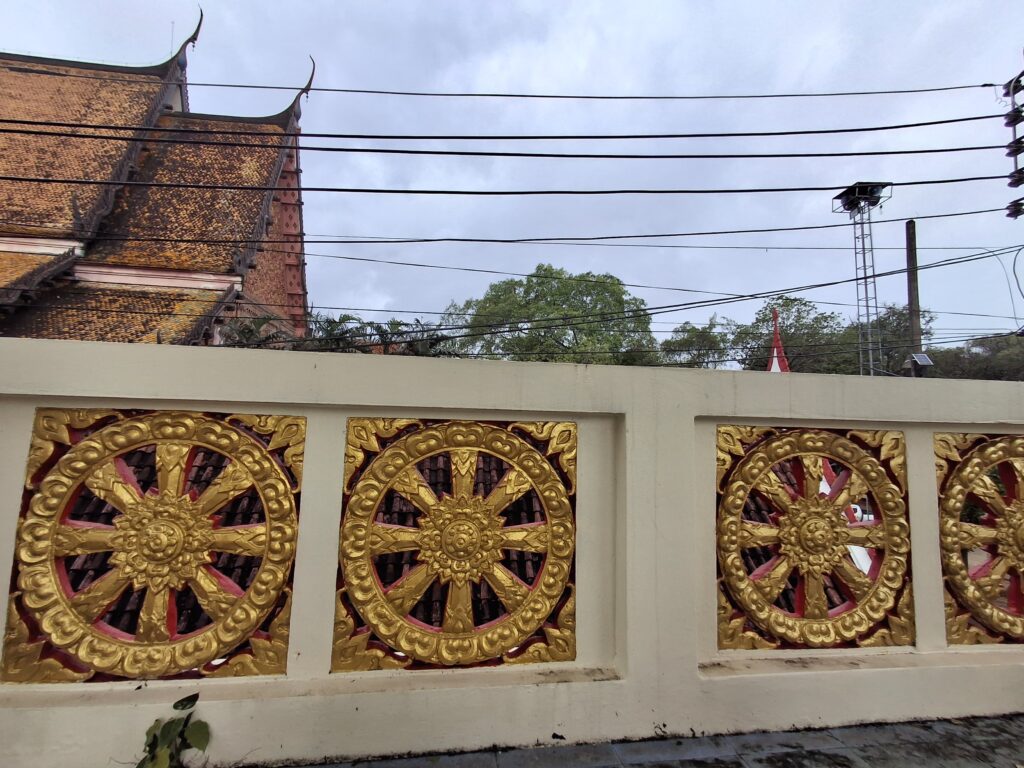
After achieving enlightenment, Buddha realized that his reasoning abilities and enlightenment would be very difficult for ordinary mortals to understand, so the best way was to seek out apostles through whom he could pass on his knowledge. He then thought of his five former companions in ascetic practice. Through clairvoyance, Buddha determined that they were living in the deer park in Sarnath, on the outskirts of Varanasi (Banaras). During his teachings, he “set in motion the wheel of dharma,” or the doctrines of the Buddhas. In his first sermon, Buddha spoke of the middle path between the extremes of indulgence and mortification, describing both as fruitless. He also created the “FOUR NOBLE TRUTHS.” And it is precisely these four elements that we will examine closely.
- THE FIRST TRUTH is the truth of suffering, which states that existence in all spheres of rebirth is characterized by suffering. Human suffering is birth, aging, illness, death, loss of friends, encountering enemies, and not finding what one desires.
- THE SECOND TRUTH identifies the cause of this suffering as immorality, negative deeds of body, speech, and mind that produce karma, resultin
 g in future physical and mental pain. These actions are motivated by negative mental states called klesha (afflictions), which include desire, hatred, and ignorance, the false belief that there is a permanent and autonomous “self” amidst the impermanent components of mind and body.
 - THE THIRD TRUTH is the truth of cessation, the postulate of a state beyond suffering, called Nirvana. If ignorance, which motivates desire and hatred, is eliminated, negative actions will not be committed and future suffering will not be produced. Although such reasoning would prevent future negative actions, it does not seem to explain the enormous stockpile of negative karma accumulated in previous incarnations that has not yet borne fruit. However, insight into the lack of self, cultivated at a high level of concentration, is said to be so powerful that it also destroys all seeds of future rebirths.
- THE FOURTH TRUTHthe path, is this method. The path has been outlined in many ways, often as the three trainings in ethics, meditation, and wisdom. In his first sermon, Buddha described the Eightfold Path: right view, right intention, right speech, right action, right livelihood, right effort, right mindfulness, and right meditation. A few days after his first sermon, Buddha presented the doctrine of no-self (anatman), at which point the five ascetics became arhats, or those who have attained liberation from rebirth and will attain nirvana after death. They became the first members of the sangha, the community of monks.
Buddha taught for 45 years after his enlightenment, traveling with a group of disciples throughout northeastern India, teaching the Dharma to those who wanted to listen, gaining followers from all walks of life. He taught some the practice of refuge; others he taught the five precepts (not to kill people, not to steal, not to engage in sexual misconduct, not to lie, and not to use intoxicants); and some he taught the practice of meditation. Most of Buddha’s followers, however, did not renounce the world and remained in secular life. Those who decided to leave home and become his disciples joined the sangha, the community of monks. At the request of his widowed stepmother, Mahaprajapati, and women whose husbands had become monks, Buddha also established an order of nuns. The monks were sent out to teach the Dharma for the benefit of gods and humans. Buddha did the same: every day and night, he scanned the world with his all-seeing eye to find those he could benefit, often traveling to them using his supernatural powers.
I WISH TO KNOW SKANDHAS BEFORE
As I searched for the essence of Buddha’s teachings, I stopped at the concept of the five SKANDHAS, which I will explain because I believe it is essential in today’s world where there is a lack of attachment and loneliness. Skandhas from Sanskrit or khandhas means “collection, group, cluster.” In Buddhism, this refers to the five aggregates of attachment, the five material and mental factors that participate in the continuous process of desire, attachment, and aversion caused by Avijja, or ignorance. These five aggregates are the factors that make up the personality and character of a sentient being. The five aggregates or groups of attachment are:
- form, sense objects (or material image, impression) (rūpa)
- sensations (or feelings of pleasure, pain, or indifference (both physical and mental), arising from the combination of the senses, sense objects, and consciousness) perceptions (or the nature of recognizing signs – making distinctions) (samjna, sañña)
- mental activity, formations, or fixations (saṅkhāra)
- consciousness (or the nature of cognition) (vijnana, viññāṇa).
In the Theravada tradition, dukkha (distress, “suffering”) arises when one identifies with or becomes attached to the aggregates. This suffering is eliminated by abandoning attachment to the aggregates. Both the Theravada and Mahayana traditions assert that the nature of all aggregates is inherently devoid of independent existence and that these aggregates do not constitute any kind of “self.”
I hope that this episode has helped you understand at least a little bit about the origins of Buddhism and what led to the creation of these beautiful temples. I apologise, but I will leave the temple I was going to write about for another article, as in this one I wanted to focus on Buddha himself. It is an amazing topic and very real to me, although there are many unknowns in history, but I am happy that I am on the right track. I sincerely hope that you are too, as it will help you achieve peace and find greater meaning in this strange world where there are no signposts and the path is filled with chaos. In the next chapter, I will present the temple I was going to write about. I apologise and hope to see you again soon.