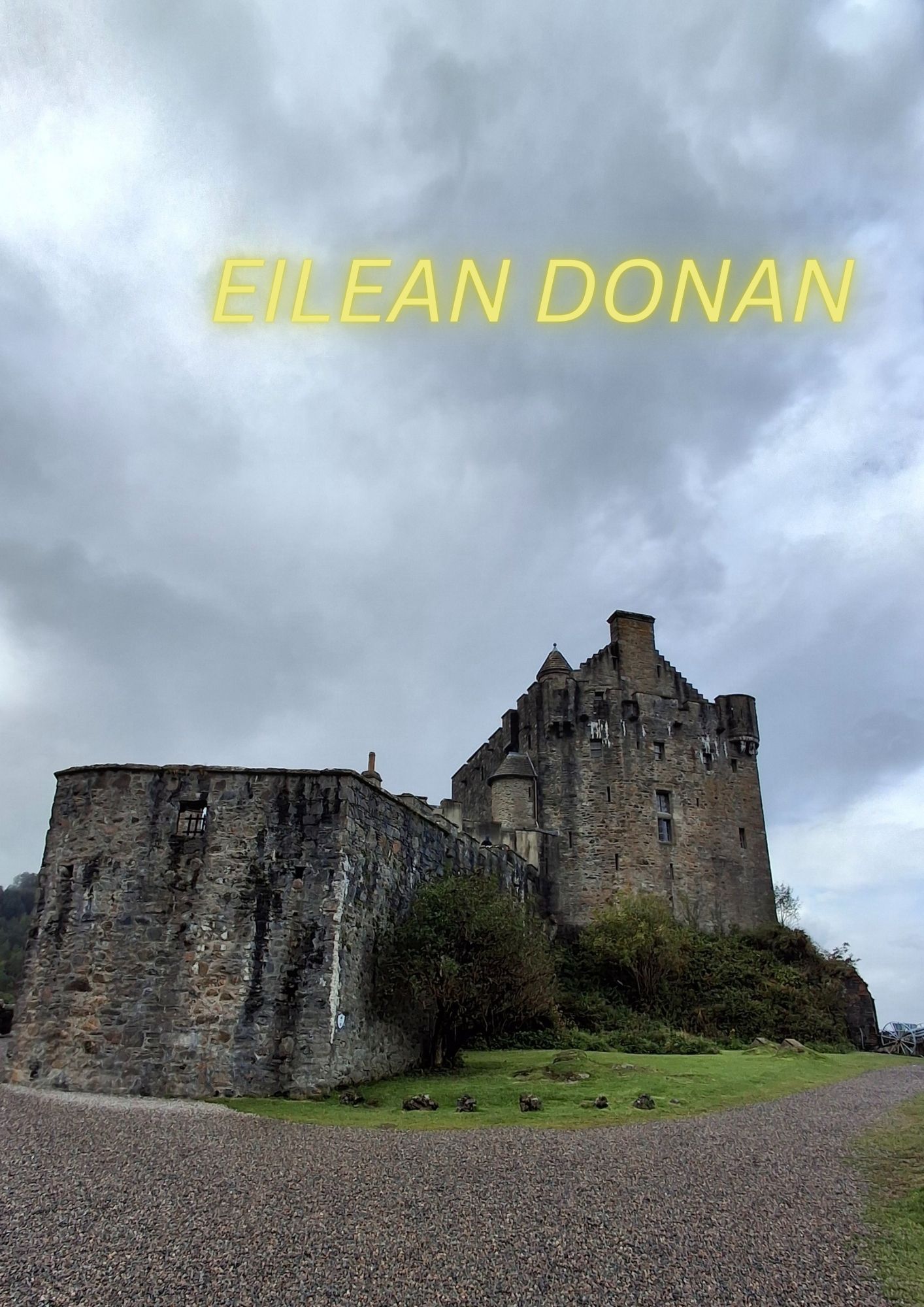
INTRO
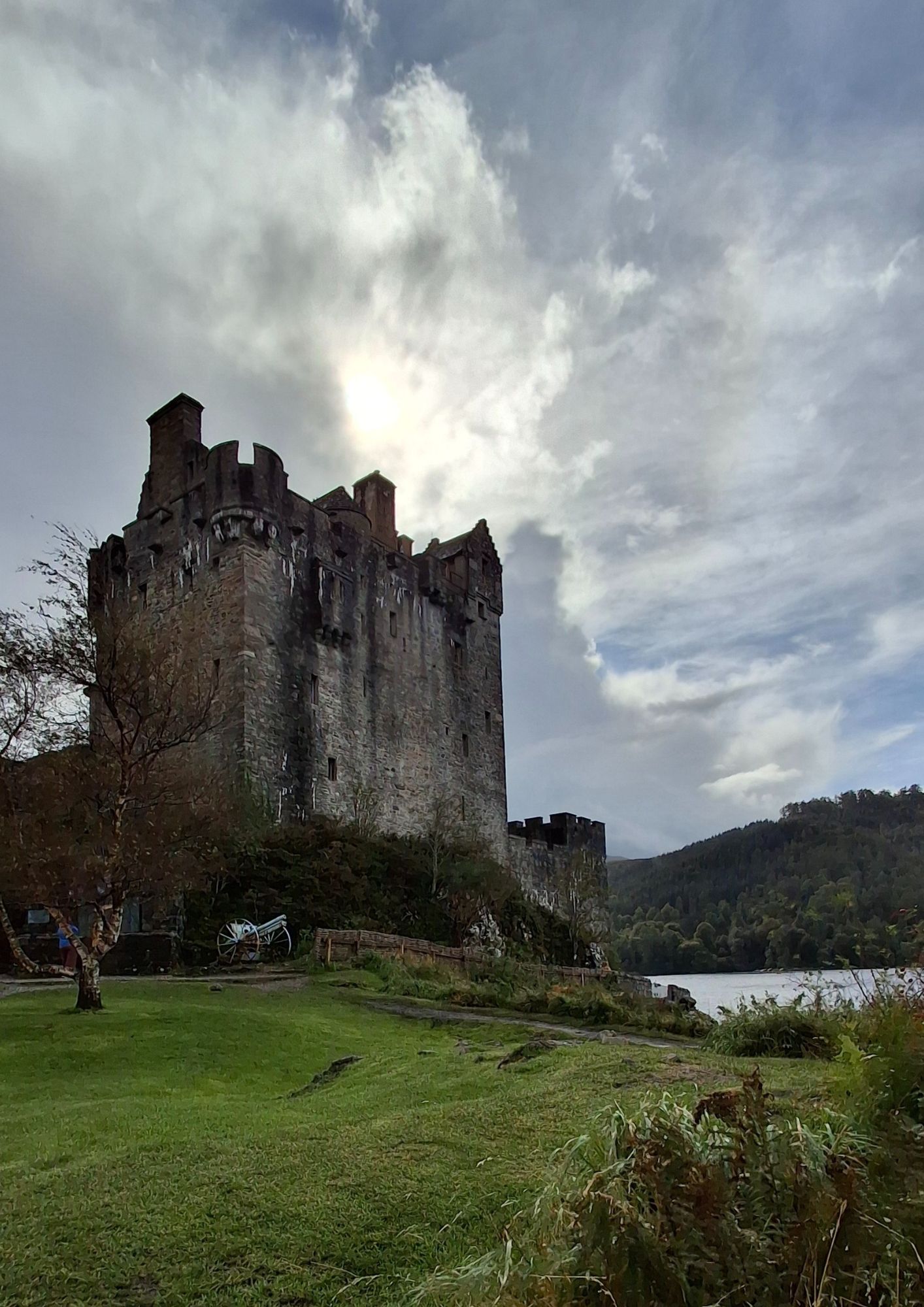
Highlander welcomes you to another episode that I have been eagerly awaiting. I must admit that when the time comes to write another story to share with you, I feel an incredible surge of energy. I would like to provide more frequent updates, but life is like a story and is unpredictable, which is why I cannot do everything at once. I hope that ordinary people who face everyday difficulties will understand me and remain patient while waiting for more stories from Highlander. This time, I’m going to tell you about a very well-known place which has an incredible history and which you simply cannot pass by without taking notice. Join me on a historical journey through Eilean Donan Castle
WHERE DOES THE NAME COME FROM?
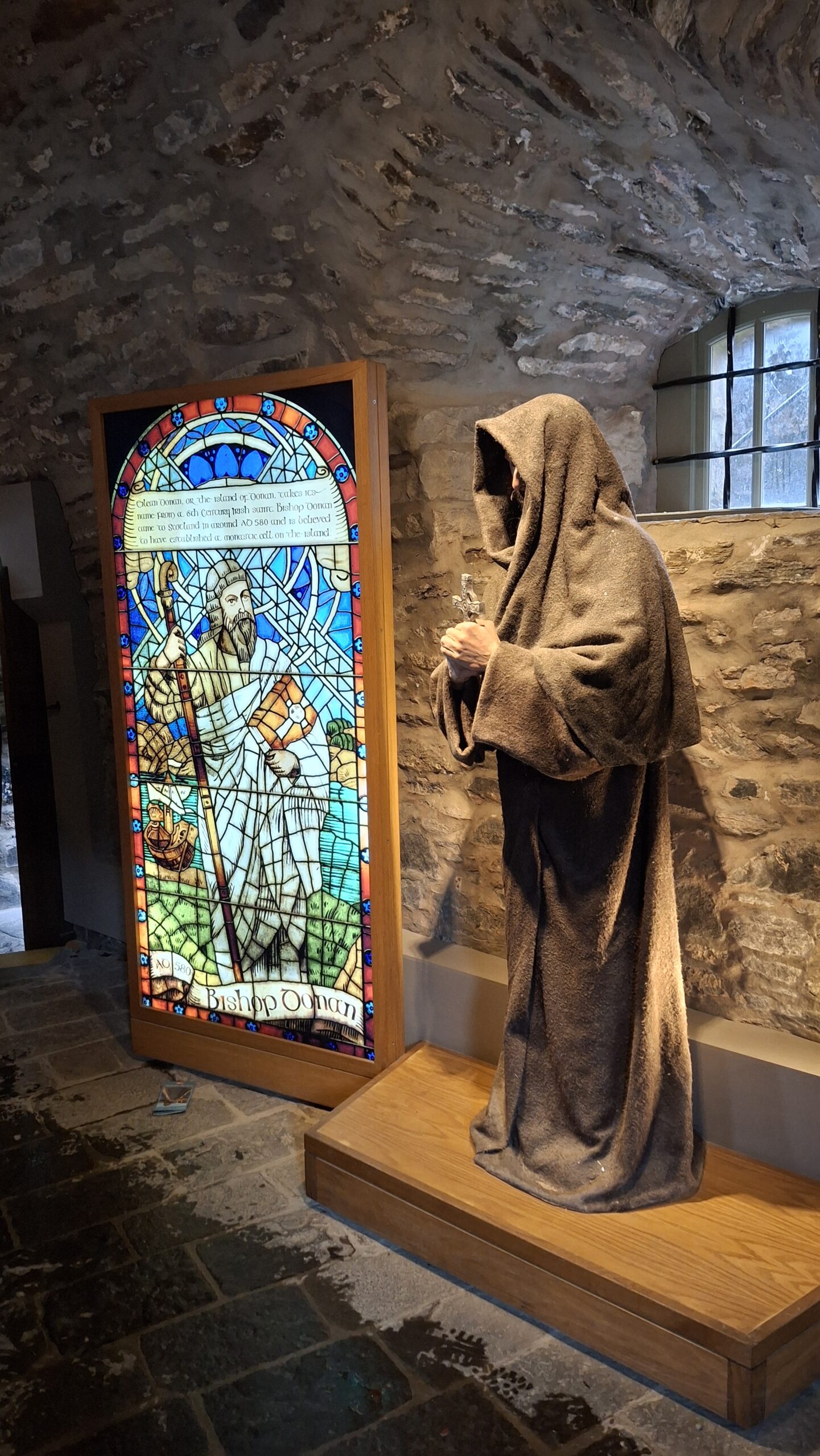
The island on which the castle stands has a long history dating back to prehistoric times. The name Eilean means ‘island’ in Gaelic, and Donan is the name of a holy bishop from Eigg who came to Scotland from Ireland around 580 AD. Those were the days when Columbus’s missionaries spread Christianity in Irleand. It is therefore believed that the name of the island and subsequently the castle was derived from this name. Many ancient legends also tell of the origin of the name of the legendary Gaelic King of Otters in a silver coat buried under the castle. The Gaelic name for otter is Cu Don, meaning ‘brown dog’, hence Eilean Donan may be ‘Otter Island‘ and otters can still be found in the vicinity of the castle today.
INCREDIBLE HISTORY
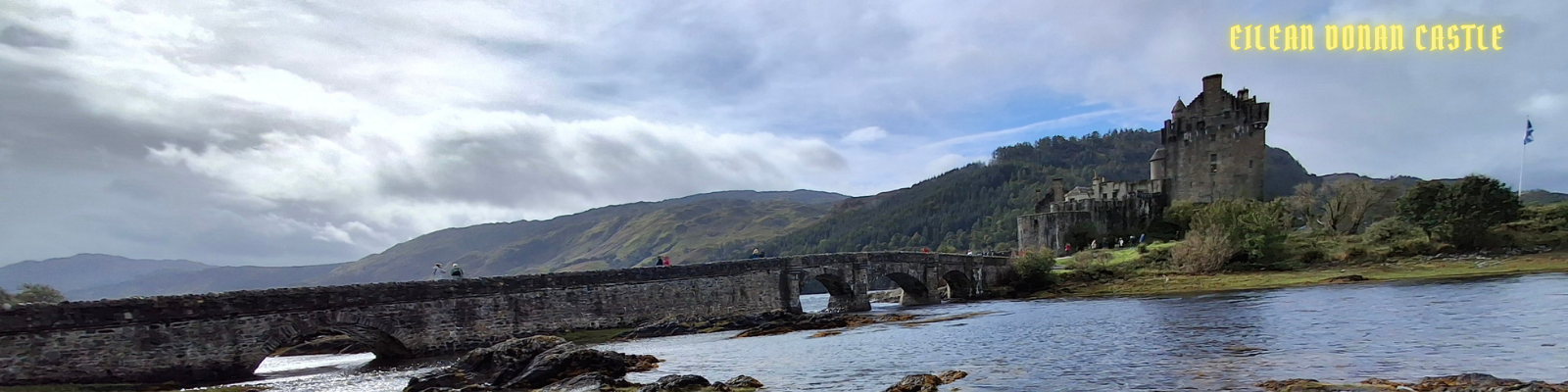
Eilean Donan Castle is located in a beautiful spot where Loch Alsh, Loch Duch, and Loch Long meet. This location is not only majestic but also important from a geographical point of view. The tidal island is an ideal vantage point and defensive position. It is therefore not surprising that this location was chosen for the castle, whose history dates back to the 13th century, specifically to 1220. It was built by the powerful ruler Alexander II as protection against Viking raids and, after his death, passed on to Alexander III. In the 13th century, the castle was owned by Kenneth MacKenzie. Part of its history involves conflicts between the MacKenzie clan and the Earls of Ross, as well as connections with the MacRae clan, who settled in Kintail at the beginning of the 14th century and became protectors of the MacKenzie clan. And here we come to the point where a highlander must pause and ask an interesting question. Did you know that the name MacKenzie translates from Gaelic as “Sons of Kenneth”? You may ask, where did these sons come from? They come from the name Coinneach, or Kenneth, the first son of the daughter of a local chief named Matheson in Kintail, who married Calean Fitzgerald. He was a trusted lieutenant of Alexander III, especially in the Battle of Largs. As a reward, he was given the title of constable of Elien Donan Castle. …………………..
………..The year 1331 witnessed a grim event in which 50 criminals were executed and their heads displayed on the castle walls. At the beginning of the 16th century, Alexander, Earl of Huntly, acting on behalf of King James IV, took control of these two castles{ Eilean Donan and Stornoway} as part of military operations aimed at subjugating the islands {Hybryd and Isles} and securing the king’s power. This operation was called “Rycht necessary for the danting of the llis.”The fortress was then occupied, but not for long, as the crew was rescued from the treacherous count and the castle returned to the rule of the MacKenzies. In 1509, John MacKenzie received royal privileges for the land of Kintail and, consequently, privileges for Eilean Donan Castle. Since then, the castle has been the frequent residence of the MacRae clan, who generally work as guards for the MacKenzies and therefore became the castle’s constables in 1511.
Eilean Donan is a very typical medieval Gaelic tower house from the time of the great sea chiefs of the Gaelic West Highland archipelago, known as the “Lords of the Isles.” These kings of the maritime empire ruled by Birlinna (Scottish drakkar) and Claymore, as well as Eilean Donan Castle, witnessed many conflicts during that time. In 1539, Donald MacDonald of Sleat attacked Eilean Donan Castle with 50 Birlinns, challenging the authority of King James V in his quest for power. The famous attack was thwarted by Duncan MacRae, who was lucky enough to fatally wound Donald with his last arrow. The hole left by the shot from which Duncan fired his last arrow can still be seen today on the wall of the Great Well.
In the mid-17th century, even Cromwell’s troops captured the castle and ruled brutally in Kintail. The demands of the MacRaes of Inverinate for food and fuel were so great that the castle garrison incurred the wrath of the clan, and their leader, John Campbell, was cut in half. For those who follow my history, the castle’s story is further linked to the Jacobite uprising. In 1715, Jacobite members of the Kintail clan captured Eilean Donan for the king and gathered here before heading south to Sheriffmuir to support the Earl of Marr for King James and the Duke of Argyll for King George I. On the walls of the Banquet Hall, there is a magnificent painting commemorating this event. Legend has it that the MacRaes died in the heart of the battle, and that Kintail was left with 58 widows after the battle.
POWDER BARRELS AND THE DESTRUCTION OF THE CASTLE
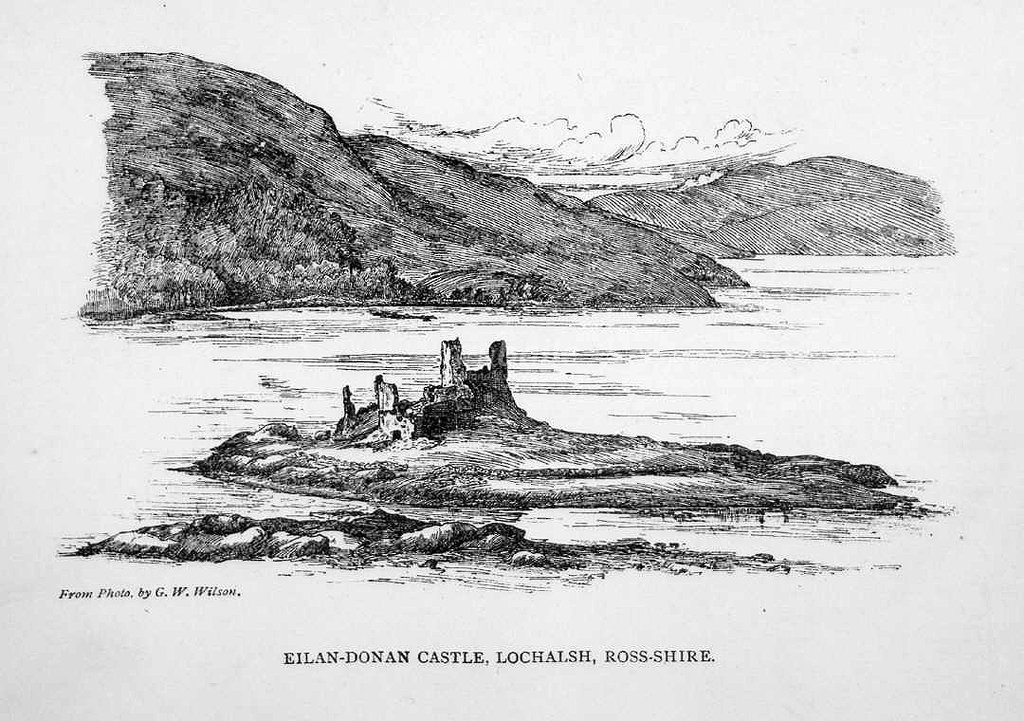
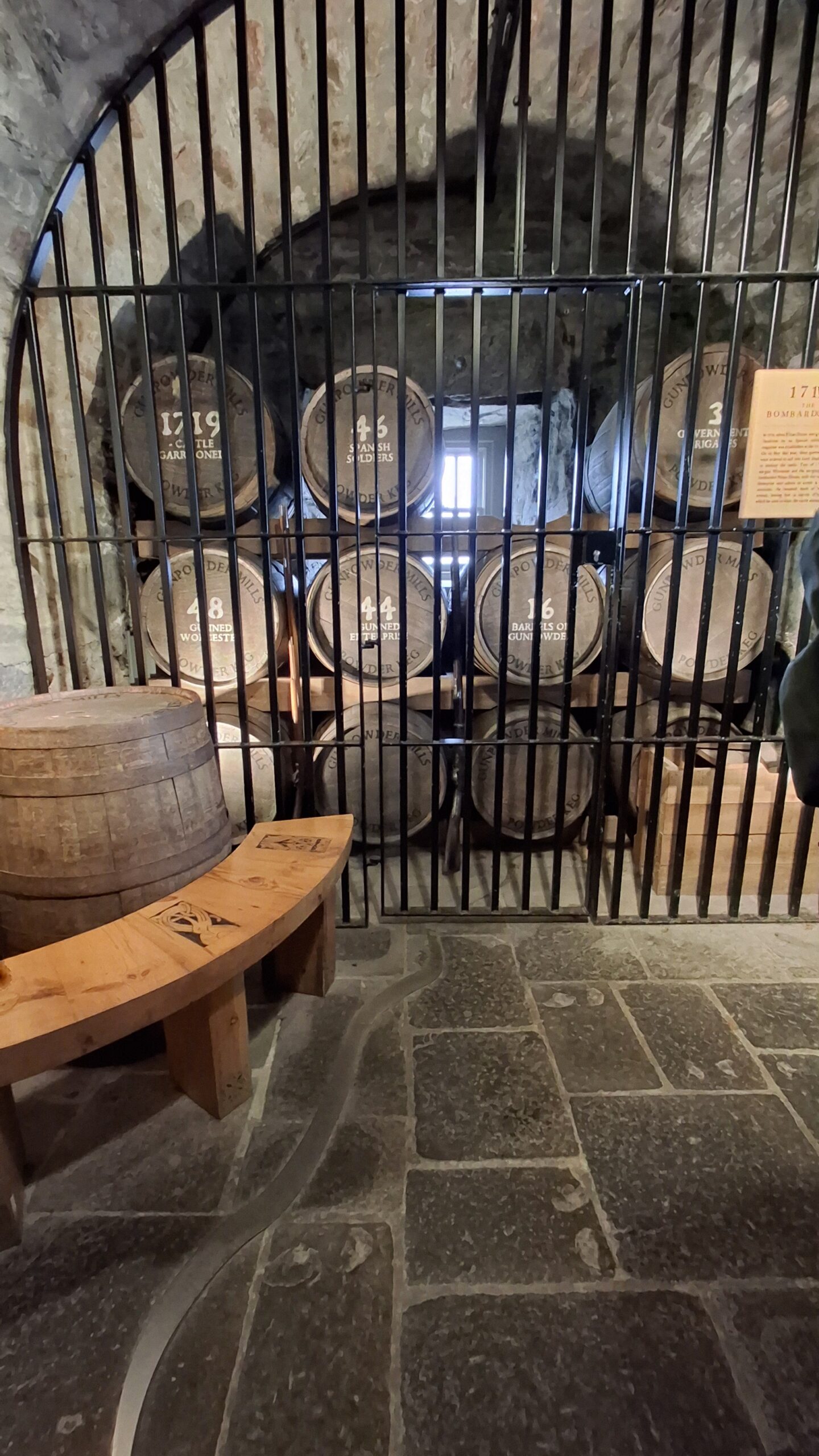
However, for me, the most important historical chapter of this castle began after the failure of the Jacobite uprising in 1715. The Jacobites, supporters of the exiled James Stuart, the “Old Pretender,” sought new support, and the Spanish proved to be that support. In April 1719, General Keith arrived at Loch Duich with his men and a group of 300 Spanish marines, who occupied Eilean Donan Castle. As you probably already know from reading my article on the Battle of Glenshiel, England could not ignore this.. Therefore, at the beginning of May, the Royal Navy sent its ships to the region. Early in the morning on Sunday, May 10, HMS Worcester, HMS Flamborough, and HMS Enterprise anchored off the coast of Eilean Donan and sent a boat flying a flag of truce ashore to negotiate. When Spanish soldiers in the castle opened fire on the boat, it was withdrawn, and all three ships bombarded the castle for over an hour. The next day, the bombardment continued while the landing was being prepared. In the evening, under cover of heavy cannon fire, the ships’ boats reached the shore and captured the castle without much resistance. According to the Worcester’s logbook, the castle contained “an Irishman, a captain, a Spanish lieutenant, a sergeant, one Scottish rebel, and 39 Spanish soldiers, 343 barrels of gunpowder, and 52 barrels of musket shot.”Over the next two days, Captain Herdman’s forces destroyed and plundered the castle. Herman even dared to use the gunpowder he found to blow up the castle as a warning to others not to rebel again. In my historical research, Highlander likes to speculate, and I wonder if the decision to blow up the castle was not too hasty and, in the heat of the moment, the fortress could have been used to establish a checkpoint for years to come, but I will probably find out more about this, as every story leaves many questions unanswered, e.g., what if the Jacobites had not left the castle before the bombing, it probably would not have been destroyed and would have left more history to remember. Before the castle was blown up, the Spanish prisoners were taken aboard the Flamborough and transported to Edinburgh. The remaining Spanish troops were defeated on June 10 in the Battle of Glen Shiel, which you can read about in my previous story, which I highly recommend.
RECONSTRUCTION OF THE CASTLE
The current form of the castle is quite recent, as it was rebuilt in July 1932 and construction took 20 years. It owes its contemporary appearance to Lt Colonel John Macrae-Gilstrap, who bought the island in 1911, together with his construction manager Farquar Macrea. Although some descriptions say that construction lasted from 1914 to 1949, when the bridge was also added.
It is also worth noting that many films have been shot on or around this romantic castle, including my favorite Highlander (1986), The World Is Not Enough (1999), The Princess Switch 3 (2021), and Made of Honor (2008). Other notable appearances include Entrapment (1999), Elizabeth: The Golden Age (2007), and the BBC mini-series Oliver’s Travels.
This castle is an amazing building worth visiting at any time of the year. Personally, I plan to visit it again in winter when everything is covered with snow and you can feel the incredible atmosphere. While studying and writing about Eilaen Donan, I learned a lot and some things started to make sense. Thanks to this, I already have another plan to travel to Dublin to determine the origin of the island’s actual name. Perhaps the Book of Kells will help me with this? Who knows, maybe one day I will have the pleasure of seeing a monastic brioche that has been preserved in northern Scotland, similar to the one that existed before the castle on the island of Eilean Donan. Soon, another part of my historical journeys, where I will try to show the truth and what is most important, so as to bring us closer to history and thus bring us closer to ourselves. Respect and best regards.